Two Fulfillment Quotes, Same Catalog. What Measurement Actually Sets the Price
A fulfillment rate card is a record of problems carriers and warehouses solved decades ago, and knowing which dimension drives each line tells you where the extras will land.
Two providers quote the same catalog and the numbers land a third apart, which almost never means one of them is cheap. It means the two rate cards were built from different assumptions about your boxes, your order profile, and how long inventory sits before it moves. A fulfillment quote is not really a price. It is a model of your business expressed in cents, and the model was assembled out of operational problems that warehouses and parcel carriers solved at various points over the last fifty years. Reading it well starts with knowing which problem each line was written to answer.
The rate card is a record of old arguments
Warehousing was priced by floor space long before it was priced by pallet position, and the shift came when racking made vertical cube usable and square footage stopped describing what a customer was actually consuming. Parcel pricing moved the same direction later. Carriers charged by weight until light, bulky freight began filling trailers without filling scales, and dimensional weight rules, applied broadly to ground shipments in 2015, repriced air inside a carton as if it were mass. Labor got unbundled next. Each of those changes left a line on the modern quote, and each line still carries the shape of the dispute that created it.
Larger providers tend to show more lines, not fewer, which reads as nickel-and-diming and usually is not. A single-site operator can absorb an awkward SKU inside a blended per-order rate because the variance stays small against their book. A provider running six or eight nodes cannot, because the same SKU behaves differently in a building with low ceilings than in one with thirty-two-foot clear height, and the cost difference has to live somewhere visible. Unbundling is how a multi-site network keeps its pricing honest across buildings that are not interchangeable.
Four measurements decide most of the number
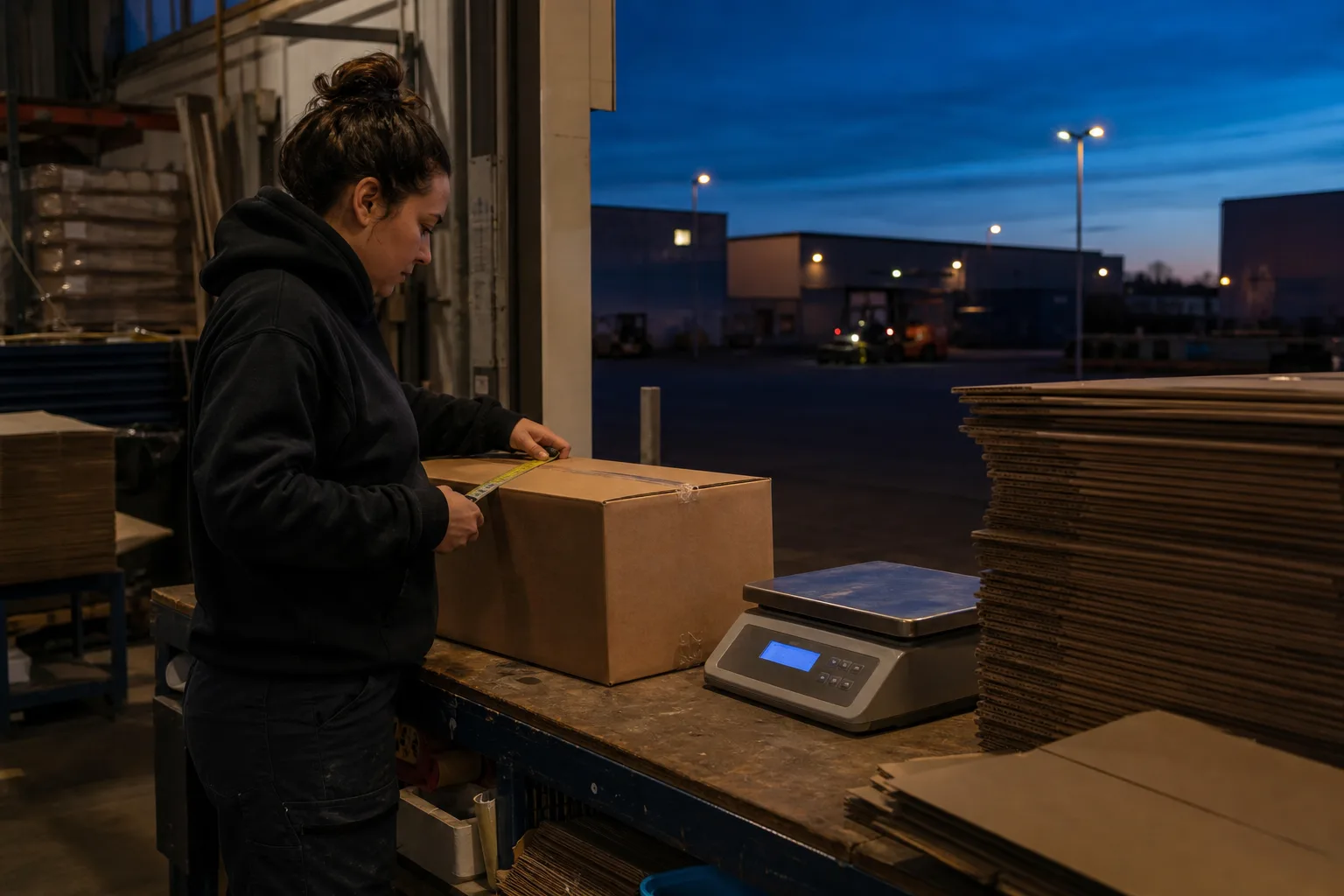
The first is the longest side of the shipped carton, because once it crosses a carrier's threshold the parcel leaves the automated sort and becomes a handling exception with a surcharge attached. The second is cube, length times width times height, which sets dimensional weight and also sets how many units fit a pallet position in storage. The third is actual weight, which still governs below the dimensional break. The fourth is the one people forget: units per order, because picking cost is a function of touches, not value. A glance at a product photo tells you none of these. A tape measure and a scale tell you all four.
This is where a quote goes wrong before anyone signs it. Clients supply product dimensions rather than shipped dimensions, omitting the void fill, the mailer, and the extra inch a corrugated box adds on each axis. The provider prices from what it was given, then rebills from what it scanned on the dimensioner at the pack bench. The gap is rarely malice. It is the difference between a specification sheet and a box on a belt, and the fastest way to close it is to ship a dozen representative orders yourself and measure what leaves the building.
The charges that start before anything ships
Receiving is billed by the unit, the carton, the pallet, or the hour, and which basis you get depends on how your freight arrives. A floor-loaded container of mixed cartons takes a crew most of a shift to break down and put away. A palletized, labeled, ASN-matched delivery takes a forklift and a scanner. Large providers publish both rates and will quote the better one only if inbound compliance is written into the agreement, with carton labels, purchase order references, and appointment windows specified. Storage then runs monthly by position or by cube, which means slow-moving inventory quietly becomes the second-largest line on the invoice.
The National Institute of Standards and Technology is responsible for the measurement standards that sit under commercial weighing and dimensioning equipment, which is why a provider's scale readings and dimensioner captures carry weight in a billing dispute. Ask what equipment measures your cartons and whether the captured dimensions appear on the invoice detail. A network that can show you the scanned cube per order is a network you can audit, and the ability to audit is most of what you are buying when you move from a blended rate to an itemized one.
Where the extras actually appear
Accessorials cluster in three places. On the carrier side: residential delivery, address correction, fuel, oversize, and seasonal peak surcharges that larger providers may partially absorb through negotiated agreements they will not fully disclose. On the warehouse side: kitting, bundling, inserts, gift wrap, special labeling, and returns processing, each priced per touch because each is a touch. On the account side: minimum monthly volumes, implementation fees, integration work, and a storage minimum that holds even in a slow quarter. None of these are hidden. They are simply not in the per-order number that gets compared across proposals.
The comparison that works is a modeled invoice. Give every bidder the same month of real order history, including the oversized items, the multi-line orders, and the returns, and ask each to produce a full charge sheet against it. A provider with scale will do this readily, because their costing team already does it internally before they bid.
Measure the cartons first, then the order profile, then ask for the modeled invoice. Pricing stops being a negotiation at that point and becomes arithmetic you can check.