Standing Water and a Clipboard. Which of the First Decisions Can Actually Wait
Two clocks run after water gets into a house, and only one of them is physics. A plain reading of what the forms on the first truck commit you to.
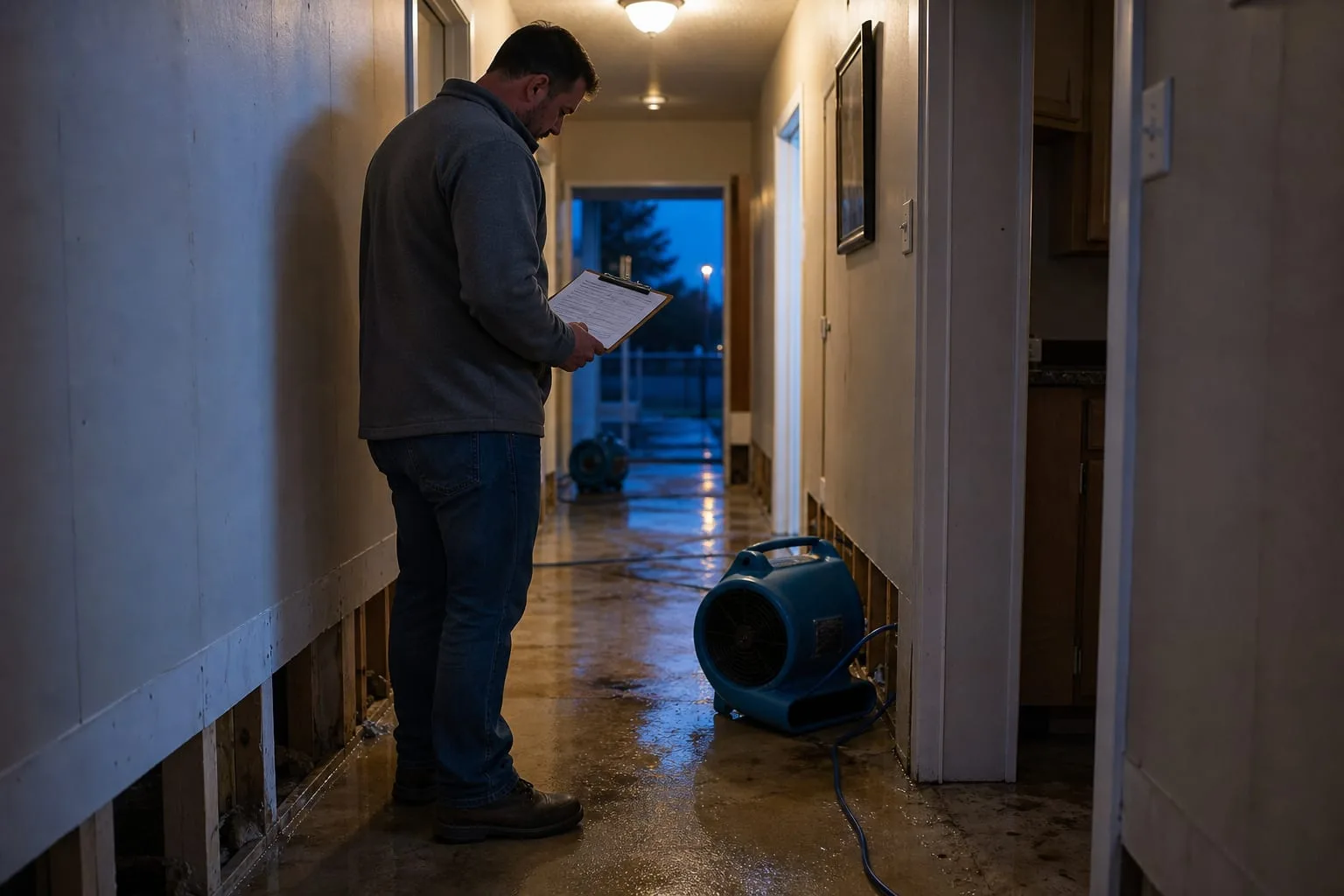
There are two clocks running in a flooded house, and they are frequently confused for each other. The first is physical: water moves through drywall, subfloor and insulation by capillary action, and every hour it travels means more material to dry or remove. The second is commercial: a restoration company wants a signature before it leaves the driveway, because an unsigned job is a truck roll it cannot bill. Both clocks are real. Only the first one is about your house, and a household that can tell them apart makes better decisions in the first forty-eight hours than one that cannot.
The judgement worth building, then, is not speed. It is the ability to sort a short list of genuinely time-critical actions from a longer list of decisions that merely arrive early. Extraction is urgent. Killing the power to a wet circuit is urgent. Choosing who repairs your kitchen, and on what payment terms, is not urgent at nine o'clock at night, even when someone standing in your hallway implies that it is.
What the form on the clipboard actually says
The document handed over in the first hour is usually called an emergency services authorization, or a work authorization. Read narrowly, it does one useful thing: it gives a company permission to enter and begin mitigation, meaning the drying and removal work that limits further loss. Read as written, it often does three more. It may contain a direction to pay, which instructs your insurer to send claim funds to the contractor rather than to you. It may contain an assignment of benefits, which transfers your rights under the policy to the company, including the right to argue with the adjuster. And it frequently commits you to the repair work as well as the drying.
Those are three separate commitments wearing one signature. A household can accept the first and decline the others, and saying so out loud is a normal conversation rather than an insult. You can write on the form that authorization is limited to emergency mitigation, that no assignment of benefits is granted, and that reconstruction will be contracted separately. A firm that works this way regularly will not blink. The mitigation still starts tonight, which is the part the water cares about.
Category, class and the word mitigation
The trade sorts water by category, from clean supply water through gray water that has passed through an appliance to black water carrying sewage or flood contamination, and by class, which describes how much material is wet and how tightly the moisture is bound. These are not cosmetic labels. The category drives whether wet carpet is dried or discarded, whether drywall is opened, and whether the job requires containment. The class drives how many air movers and dehumidifiers belong in the room and for how long. When a technician says the loss is category two, class three, they have just described most of your eventual invoice.
Ask which category and class they have assigned, and ask what changes if the category is wrong. A clean supply line break that sat for two days can be reclassified upward, correctly, because bacteria multiply. But reclassification also expands scope, and scope is money. The Environmental Protection Agency is the federal body responsible for guidance on mold and moisture in indoor environments, and its framing is the useful one for a homeowner: the objective is drying the structure and removing what cannot be dried, not treating every wet surface as hazardous.
The record you build in hour two is the judgement you use in week six
Almost every dispute that surfaces a month later turns on something nobody documented on day one. Photograph each room before anything is moved, including the ceiling, the baseboards and the inside of cabinets, and photograph the source: the split hose, the failed water heater fitting, the ice-dammed valley. Note the time you discovered the water and the time you shut off the supply. If a technician takes moisture readings, ask for the numbers and the locations, because a drying log showing initial readings, daily readings and the target dry standard is what proves the equipment ran as long as it needed to and no longer.
That log is also your defense against the opposite problem, which is drying that stops early. Air movers cost money to leave in place, and a crew under schedule pressure can pull equipment when a wall feels dry to the hand while the framing behind it is still wet. Written readings against a documented dry standard settle that question without argument. Ask on the first visit whether you will receive the log, and in what form.
Two calls that belong in the first day, and one that does not
Report the loss to your insurer promptly, because policies require it and because the adjuster's file opens from that call. Separately, if the source is not obvious, get a plumber or a roofer to identify it, since a mitigation company can dry a house without ever finding out why it got wet. What does not belong in day one is signing a reconstruction contract. Mitigation and rebuild are different trades with different pricing, and bundling them the night of the loss forfeits the only leverage a household has, which is the ability to compare two written scopes when the floor is dry and the panic has drained out of the room.
Preferred vendor is the other phrase worth translating. An insurer's program contractor has agreed to pricing and reporting terms with the carrier, which speeds payment and often works out well. It does not make them your representative, and you are generally free to hire someone else. Asking whether a company is on the carrier's program, and what that changes about who approves the scope, is a fair question that a competent estimator answers in a sentence.
The households who come out of a water loss well are rarely the fastest ones. They are the ones who acted immediately on the three or four things water punishes you for delaying, then insisted on reading the rest in daylight.