Skipped the Spring Checklist Again? How Big Buildings Schedule Upkeep, and What to Copy
Facilities departments abandoned the calendar checklist decades ago in favor of triggers, criticality and a written record. The household version is shorter than you think.
The electric bill climbs about eleven percent over two summers and gets blamed on rates. The upstairs bedroom stops holding temperature and gets a portable air conditioner. A sour smell in the finished basement gets a plug-in deodorizer, then a dehumidifier, then a plumber who finds a floor drain trap that dried out because nobody had poured a cup of water into it since the house was built. Each of those is a maintenance item that arrived disguised as something else, and each got solved by spending money on the symptom. That mislabeling, rather than laziness, is what breaks most household upkeep.
The consequences nobody files under maintenance
Deferred upkeep almost never announces itself. It shows up as a refrigerator that runs warm on the top shelf, which is usually a condenser coil packed with dust and pet hair rather than a failing compressor. It shows up as a garage door that reverses halfway down, which is usually photo eyes knocked out of alignment by a bicycle. It shows up as a water heater that rumbles on recovery, which is sediment, and as a dryer that needs two cycles, which is a restricted vent. The household reads each one as a discrete malfunction. A building engineer reads all four as the same thing, an interval that was missed, and that difference in reading is most of the gap between the two.
The cost of the mislabeling compounds quietly. You buy the space heater, the second dehumidifier, the extended warranty on an appliance whose only problem was airflow, and you pay a diagnostic fee to be told something a ten minute task would have prevented. None of those purchases were unreasonable given the information at hand. They were made on a symptom rather than a cause, and the fix for that is not more discipline. It is a better filing system for what you are actually seeing.
What a facilities department does that a household does not
Any organization running more than a few buildings, a school district, a hospital system, a regional property manager, stopped using an annual checklist a long time ago, because checklists built around dates do not survive contact with a real portfolio. What replaced them has three parts. First, an asset register: a written list of every piece of equipment with a model number, an install date, and a location. Second, a criticality ranking, which decides how much attention each asset earns. Third, triggers rather than dates, so a task fires on runtime hours, a pressure reading, a season, or an event, not on the arrival of April.
The part households find surprising is the third category in the ranking. Serious maintenance programs formally designate some equipment as run to failure. Nobody inspects the hallway light fixtures on a schedule; they get replaced when they die, because the consequence of failure is trivial and the cost of a schedule exceeds the cost of the failure. That decision is written down, deliberately, so that attention concentrates on the assets where a failure floods a floor or shuts a wing. The Department of Energy, which is responsible for efficiency standards on furnaces, water heaters and major household appliances, is a useful reminder that this equipment is engineered around assumed service conditions. Clean filters and clear coils are part of the assumption.
The last piece is the record. Work orders get logged with a date, a task and a finding, and after two or three cycles the record tells you the interval instead of the manufacturer guessing. A filter that is gray at ninety days in one house and loaded at forty five in another is not a debate; it is two entries in a log. That is a system a single household can run, and it does not require software.
The questions to ask whoever is doing the work
Most people already buy maintenance from a larger organization, whether that is a seasonal HVAC service agreement, a condo association's contracted vendor, or a home warranty company. The question to put across the table is simple: what specific tasks are on the technician's sheet for this visit, and what is deliberately not on it? A strong answer is itemized and unglamorous, naming the capacitor test, the amp draw, the drain line flush, the flame sensor cleaning, and it says plainly which items are inspection only. A weak answer is a category. If you hear that they perform a full service or a complete tune-up, you have been told the price of the visit and nothing about its content.
Two follow-ups do most of the remaining work. Ask what the technician found last time and whether you can see the written record, because a provider who cannot produce the previous ticket has no interval data and is working from the calendar alone. Then ask what they recommend you handle between visits, and listen for whether the answer includes anything that reduces their billable hours. A provider who tells you to rinse the condenser coil yourself in May, and shows you where the shutoff is, is describing a real division of labor. That answer tends to come from the outfits with a proper work order system behind them.
Building the version you will actually keep
Copy the structure, not the scale. Write down the eight or ten items in the house where failure is expensive or wet: the water heater, the furnace or air handler, the sump pump, the dryer vent, the gutters and the grade around them, the washing machine supply hoses, the refrigerator coils, the smoke and carbon monoxide detectors. Everything else is run to failure, and saying so in writing is what keeps the list short enough to survive. Then attach each task to a trigger you cannot miss rather than a month you can. The first night the heat runs, the clock change, the arrival of the quarterly water bill, the last leaf drop.
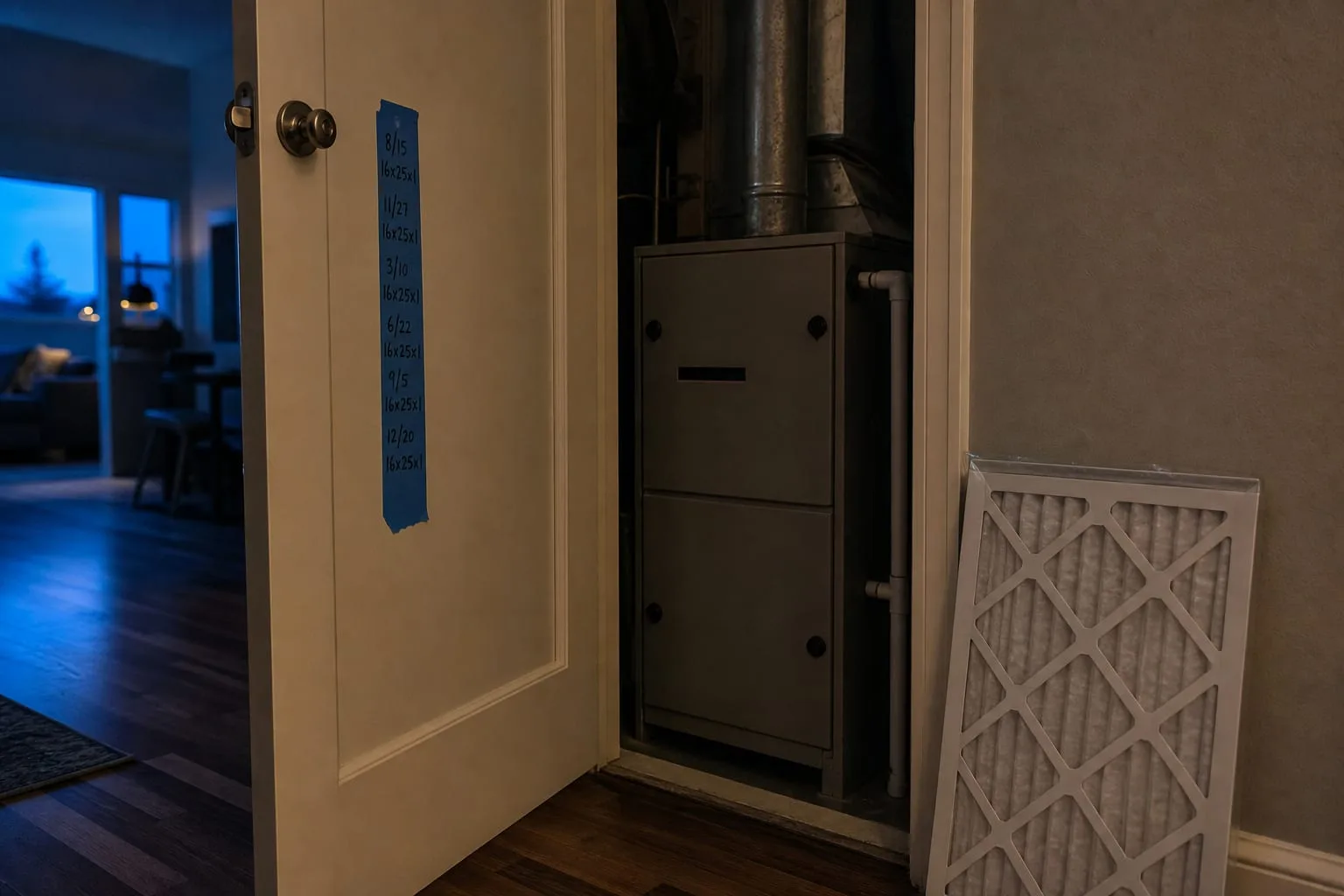
Keep the record where the work happens. A strip of painter's tape inside the furnace closet door with dates and filter sizes outlasts any app, and a single note file with a line per task and a date does the same for the rest. After the second year the log starts answering questions the manual could not: how fast your particular vent loads, whether the sump ran at all last spring, when the anode rod was actually checked. That is the point at which upkeep stops being a chore you owe someone and becomes a small body of evidence about your own house.
The next time the bill jumps or a room stops cooling, the first move is to open the record rather than the browser. Either the trigger fired and the task was done, which narrows the problem considerably, or it did not, which is a ten minute answer instead of a service call. Both outcomes are cheaper than a symptom purchase, and the second one gets rarer every year the log runs.