Same Damage, Different State. What Turns an Adequate Adjuster File Into a Good One
The terms a loss adjuster uses among colleagues each commit you to something, and the state you live in quietly changes what a well-run claim file has to contain.
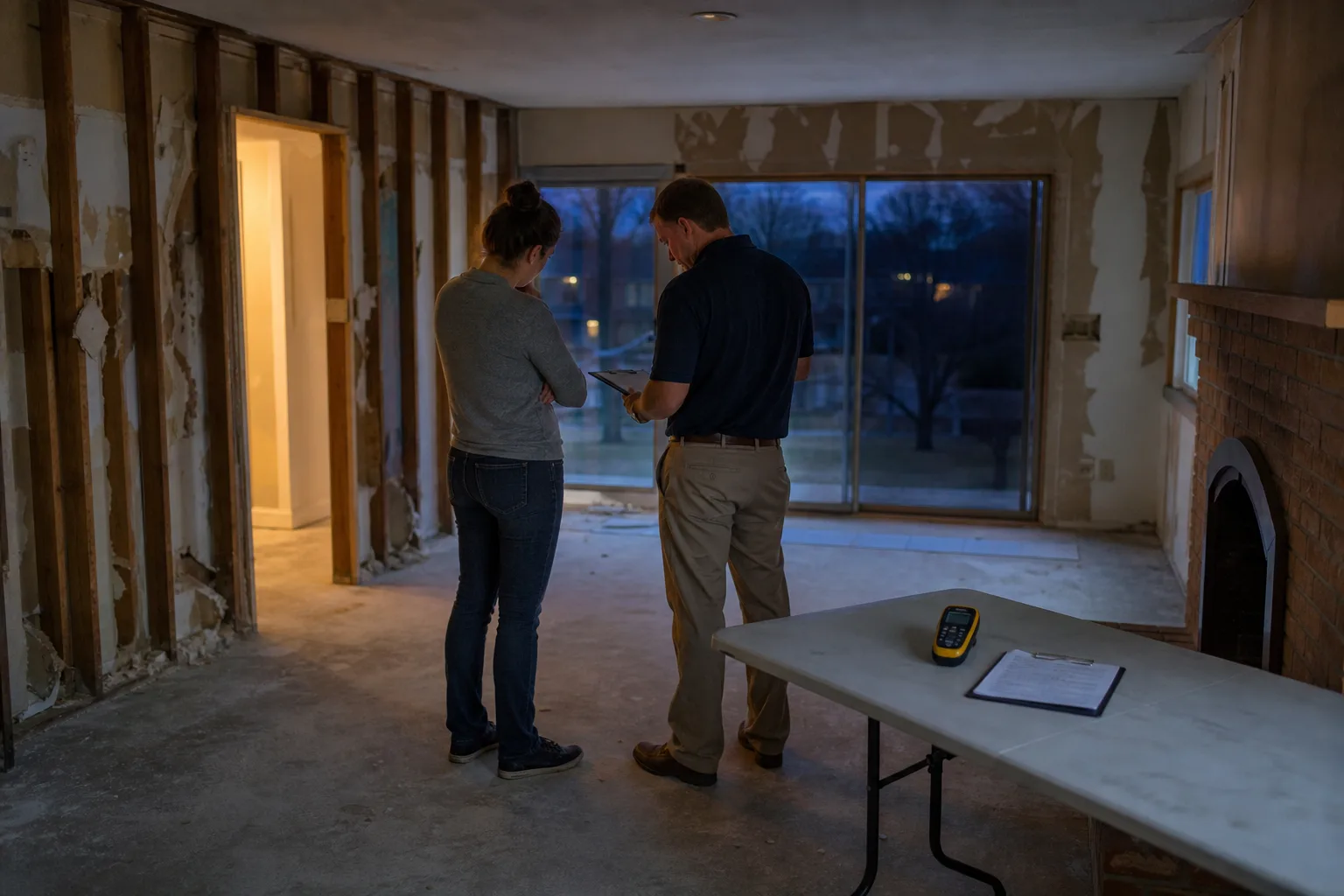
The person who walks your house after a loss is measuring two things at once: what was damaged, and what the policy says about paying for it. Those are separate findings, and the gap between them is where most claims are won or lost. A homeowner who treats the visit as an inspection will get an inspection. A homeowner who treats it as the assembly of a written record, one that another adjuster three states away could pick up and follow, tends to get a scope that matches the house. The difference is not aggression. It is paperwork, in a particular order.
Three people are called the adjuster, and they answer to different parties
A staff adjuster is an employee of your insurer. An independent adjuster is a contractor the insurer hires during volume periods, storms mostly, and works from the insurer's guidelines and estimating platform. A public adjuster works for you, is licensed separately by your state, and is paid a percentage of the settlement. Those three roles produce documents that look nearly identical and commit you to very different things. When someone says they are writing the scope, they mean the room-by-room list of line items that becomes the settlement. When they say they are pricing it, they mean running that scope through a software price list keyed to your ZIP code.
Two more terms decide the number on the check. Actual cash value is replacement cost minus depreciation, the deduction for age and wear on a roof, a carpet, a water heater. Recoverable depreciation is the withheld portion, released after you actually complete the repair and send proof. A file that records the age and condition of each damaged component gives the adjuster something to depreciate accurately, instead of applying a schedule. That is the first fork between adequate and good.
What a good file contains before anyone asks for it
Photographs are the floor, not the standard. A good file has photographs taken before mitigation begins, wide enough to place each room, close enough to read a label or a water line on drywall. It has the mitigation contractor's daily drying logs, which record moisture readings at fixed points over several days and show why equipment stayed as long as it did. It has the cut sheets or model numbers of anything destroyed, because a line item for a thirty inch base cabinet and a line item for the cabinet you actually had can differ by a factor of three. It has your receipts for temporary repairs.
Keep the materials. Restoration crews are trained to haul debris, and a demolished section of flooring is the only surviving evidence of its grade, thickness and finish. Ask them to set aside a labeled sample from each material removed, wrapped and stored in the garage. When a dispute about quality arrives six weeks later, the sample settles it in a minute, and the alternative is an argument between two estimates with nothing physical underneath either one.
The last piece is chronological. A short written log of every call, the date, the name, what was said and what was promised next, changes how a claim is handled, because it converts vague recollection into a record you can quote. Send a one paragraph email after any consequential phone call confirming what you understood. Nobody objects to that. It is simply the file, kept by the person with the most at stake.
The rules that change at the state line
Here is where identical damage produces different settlements. Matching is the clearest example: when hail destroys twelve squares of a thirty square roof and the shingle is discontinued, some states require the insurer to pay for reasonably uniform appearance across the slope or the elevation, and others leave it to policy language. Siding claims turn on the same question. Ask your state's department of insurance whether a matching requirement applies, in those words, before you accept a partial repair.
Deadlines differ too. Most states impose prompt-pay statutes fixing how many days an insurer has to acknowledge a claim, to complete its investigation, and to pay once liability is accepted. Some are fifteen days, some thirty, some run from the date of a complete proof of loss rather than the date of the loss. Proof of loss is a sworn statement of the amount you claim, and in several states it triggers the clock rather than merely documenting it. Knowing which deadline governs tells you when a polite follow-up becomes a written demand.
Public adjuster rules are state law as well. Fee caps, the contract cancellation window, and whether solicitation is restricted in the days after a declared catastrophe all vary. So does the appraisal clause: in most homeowners policies either party can invoke appraisal to resolve a dispute about amount, with each side naming an appraiser and the two selecting an umpire, but a handful of states have narrowed or conditioned it. Flood is the outlier in the other direction. Coverage written through the National Flood Insurance Program, which the Federal Emergency Management Agency oversees, uses a standardized policy and a separate adjuster, so its documentation requirements and proof of loss deadline apply the same way everywhere.
Disagreeing in the order that works
When the scope comes back short, the first move is not a lawyer and not a complaint. It is a supplement: a written request to add specific line items, each tied to a photograph, a measurement or a contractor's estimate. Most shortfalls are omissions rather than denials, and omissions get corrected quietly. If the supplement is refused, ask for a reinspection with your contractor present, so the two people with tape measures are standing in the same room. Ordinance and law coverage belongs in this conversation, because local code may require upgrades the old construction never had, ice barrier at the eaves, hurricane straps, an updated electrical panel, and those upgrades are payable only if the policy carries that coverage and the code is cited.
Appraisal comes next, and it resolves amount, not coverage. A department of insurance complaint runs in parallel and is free. Each step leaves a record the next step relies on, which is why the order matters more than the volume.
Most homeowners meet one adjuster in a lifetime and treat the visit as a verdict. It is closer to a filing. The house that gets paid properly is usually the one where somebody wrote down the model numbers, kept a square foot of the old floor, and knew which deadline the state had already set.