A Ring That Photographs Small and Weighs Heavy. Four Measurements That Set the Price
An estate jewelry purchase, reconstructed from the buyer's side, and the measurements that separated the asking price from the insurable one.
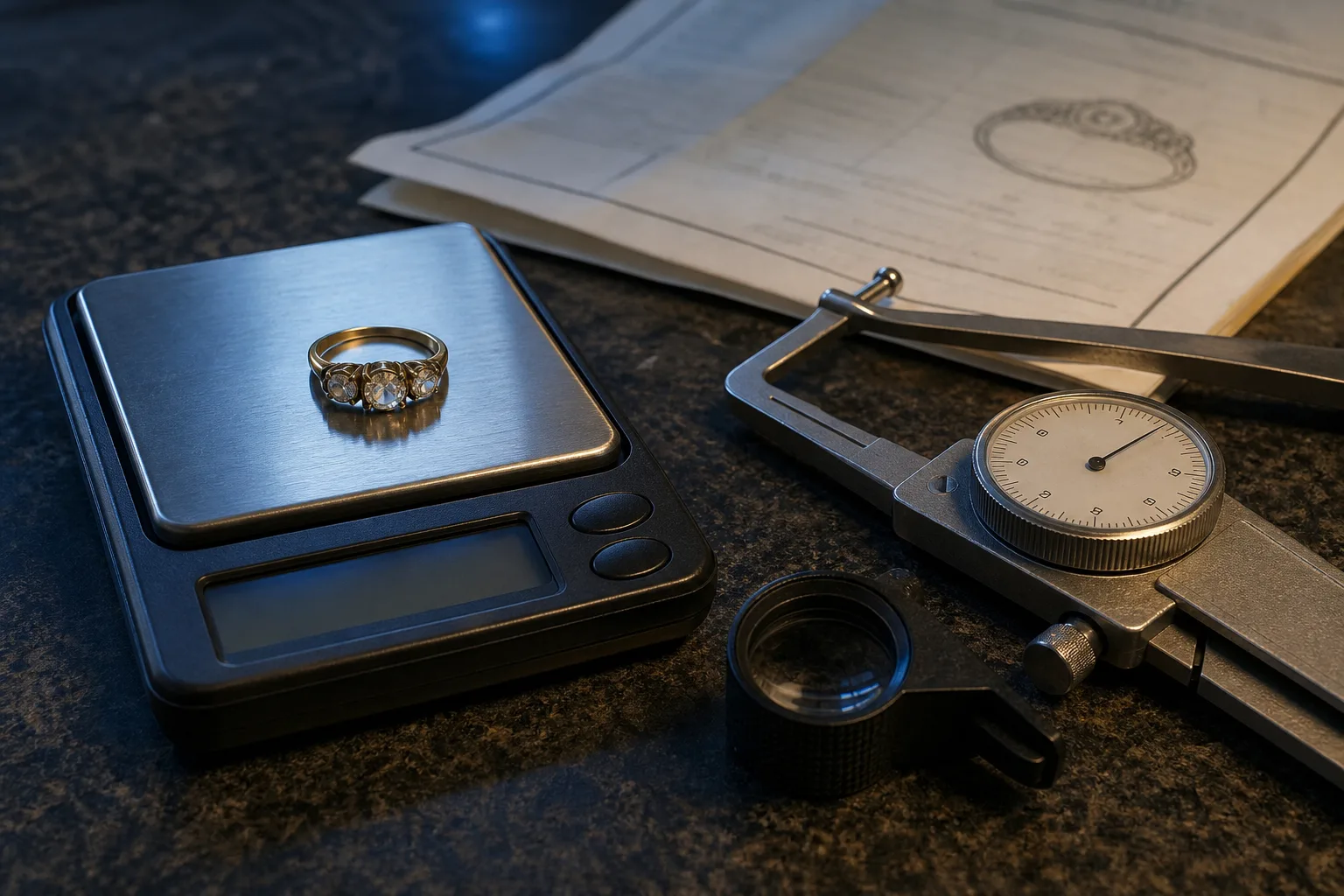
The case is ordinary enough that a version of it happens in every city with an estate jewelry counter. A buyer, shopping for an anniversary gift, was shown two rings in the same tray at what looked like the same price. One read large across the top and felt like nothing in the hand. The other read small, sat quietly, and cost within a few hundred dollars of the first. The buyer assumed the visible one was the better value, because that is what a glance rewards. A tape measure, or in this trade a millimeter gauge and a scale, told a different story, and the difference showed up later in places the buyer had not thought to look.
What the customer saw, and what the counter was measuring
From the customer's side of the glass, a stone is an outline. Width across the table, how far it reaches toward the knuckle, how much light it throws under the halogen. From the seller's side, the same stone is a set of dimensions that do not all appear in the outline. Spread is what you see. Depth is what you do not, and depth is where most of the weight lives. A shallow stone cut for face-up size can look a full size grade larger than a deeper stone of identical weight, which is why two rings can photograph so differently and price so similarly.
The buyer asked the only question most buyers ask, which is how many carats. That number is a weight, not a size, and it answers less than people expect. The more useful request, and the one the counter had ready, was the millimeter measurement across the stone and through it, plus the weight. Once those three numbers sat together, the quiet ring turned out to carry more material in a tighter package, and the wide one turned out to be spending its budget on surface area.
The metal was the second number nobody asked about
Underneath both stones was a mounting, and the mountings were not the same thing at all. One was white gold, rhodium plated, bright in the case and due for replating on a schedule nobody mentions at the point of sale. The other was platinum, heavier, duller, and roughly twice the density, which is why it felt like more ring for the same visual footprint. Platinum wears by displacing rather than shedding metal, so prongs thin differently and hold differently over twenty years. The Federal Trade Commission oversees how precious metal content is described and marked in the United States, and the stamps inside a shank are the shortest version of that disclosure a buyer will ever get.
The buyer had never turned a ring over. Inside the quiet one were a fineness mark, a maker's mark, and a worn assay stamp that placed the piece somewhere in the middle of the last century. That stamp did not make the ring beautiful. It did make it identifiable, and identifiability is what an insurer, an appraiser, and eventually an heir all need.
Where the purchase showed up again, months later
The consequences people rarely trace back to the counter arrive in the mail. The first was the appraisal. The shop supplied a document stating a replacement value, which is what it would cost to buy a comparable piece at retail, and the buyer initially read that figure as what the ring was worth. It is not. It is the number an insurer uses to set a scheduled personal property rider and a premium, and it sits well above what the same ring would bring back across the counter on a resale. Knowing which of those two numbers a document reports is the difference between a sensible rider and years of overpaying.
The second arrived at the first sizing. Antique shanks, worn thin from decades of wear, do not always take a size change without a rebuild, and a jeweler who says so before cutting is doing the customer a favor. The third was the claim conversation the buyer never had to have, because the appraisal listed the millimeter dimensions, the metal, the marks, and a photograph. A description that says gold ring with a round stone replaces almost nothing. A description with measurements replaces the actual object.
The questions that would have shortened all of it
Four requests, asked in the first ten minutes, do most of the work. Ask for the stone's measurements in millimeters alongside its weight, so that spread and depth are separated. Ask what the mounting metal is and what maintenance it assumes, because plating and prong wear are calendar items, not defects. Ask whether the appraisal states replacement value or fair market value, and who wrote it. Ask what the return window is in days and what happens to it once the ring is sized, since alteration usually ends it. None of these questions is adversarial, and a counter that answers them readily has told you a great deal about itself.
The buyer took the quiet ring. What made that the right call was not taste or instinct but the fact that, before paying, the purchase had been converted from an impression into a short list of measurable facts that any other jeweler, insurer, or appraiser could check independently.