A Kitchen Fire and Soot in Every Room. The Four Documents That Carry the Claim
After a stovetop fire, the adjuster's visit goes on paperwork, not memory. Here are the four records that decide the number, and the questions that test a weak answer.
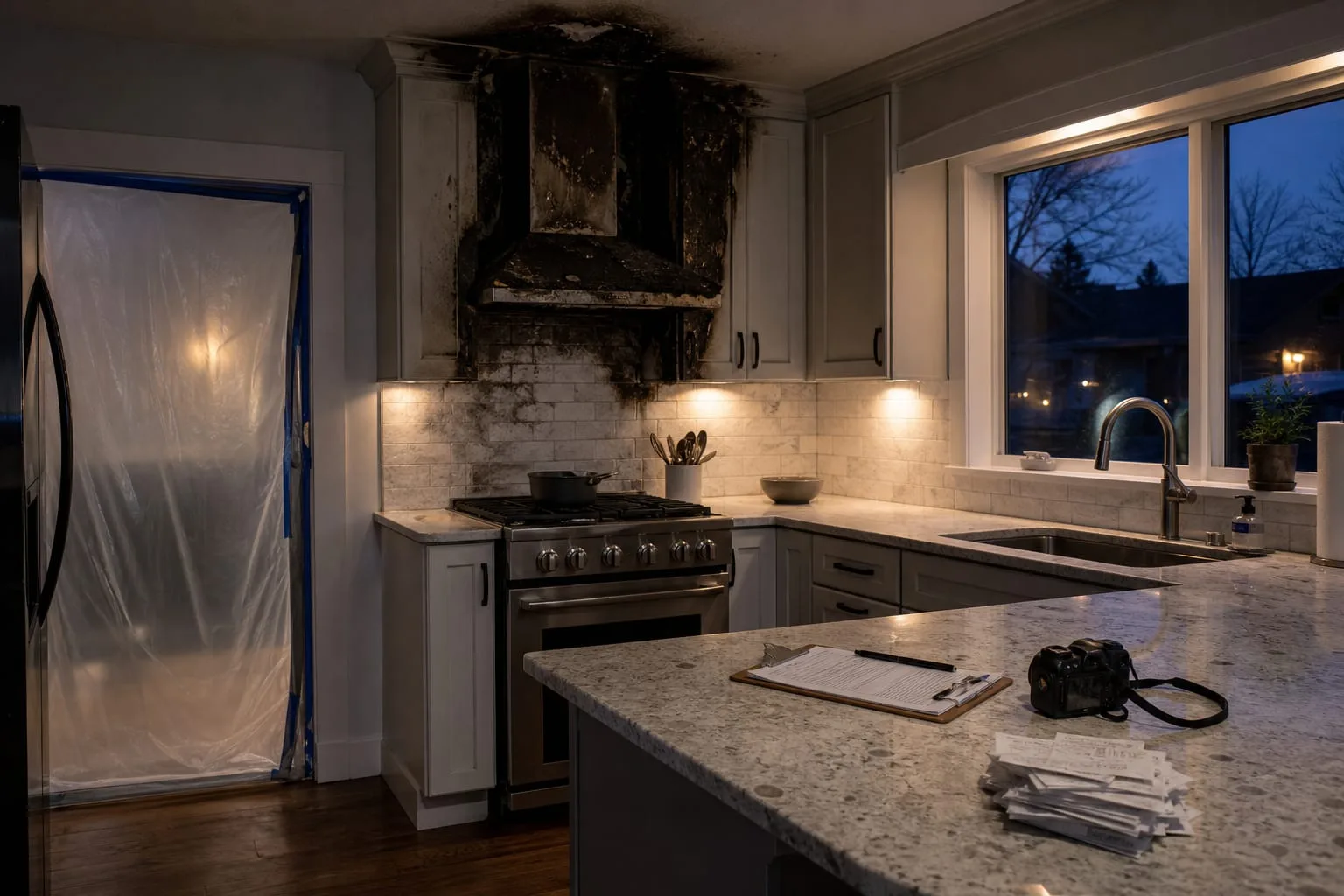
A pan of oil catches on a Tuesday evening, the fire is out in ninety seconds, and the visible damage is one scorched range hood and a blistered cabinet door. Then the smell settles into the whole house. Three days later a loss adjuster is standing in the kitchen with a tablet, and the difference between a check that covers the kitchen and a check that covers the house is not what happened that Tuesday. It is what you can hand over. Smoke claims are decided on documents, because smoke is the one loss where the damage travels further than anyone can see.
The paperwork exists because somebody once lied about a fire
The adjuster is not an improvisation. The role and most of the forms that come with it descend from the standard fire policy language that New York first imposed in the nineteenth century and revised into the 1943 version that other states copied almost word for word. That language did two things: it stopped insurers writing whatever terms they liked, and it required the policyholder to swear to the loss in writing. The sworn proof of loss, the inventory, the duty to cooperate, the appraisal clause: all of it is residue from an era when fire claims were settled by argument and occasionally by fraud. Knowing that changes how the visit feels, because the requests are not personal.
The U.S. Fire Administration, part of FEMA, is responsible for tracking residential fire causes and losses nationally, and cooking equipment sits at the front of that picture year after year. Which is another way of saying your kitchen fire is a category, not an anomaly. Adjusters have seen the pattern, and there is an established scope of work for it.
Four records, and the order they matter in
The first is the scope sheet, which is the adjuster's own document: a room-by-room list of line items, usually written in estimating software that prices labor and materials by ZIP code. You are entitled to a copy. Ask for it before you sign anything and read it as a list of what was included, not as a total. The second is the contents inventory, which is yours. Room, item, age, what you paid, what it replaces for. Photograph the tags in clothing and the model plates on appliances. Smoke residue is acidic, and electronics, upholstery, and anything with a fabric core often fail the test that a wiped-down countertop passes.
The third is the additional living expense ledger, which people start too late and stop too early. If your family eats out for a week because the kitchen is sealed under plastic, the claimable amount is the difference between those restaurant receipts and what groceries would ordinarily have cost, which means you need both sides of the arithmetic. Keep hotel folios, mileage, and boarding fees for a dog that cannot stay in the house. The fourth is the proof of loss itself, a sworn statement of the amount claimed, typically due within a window measured in days after the insurer sends you the form. That deadline binds you whether or not the adjuster mentions it again.
The questions to ask while the adjuster is still in the room
Ask who they work for. A staff adjuster is an employee of the carrier, an independent adjuster is a contractor assigned by the carrier, and a public adjuster works for you for a percentage. All three are legitimate, and the answer should come in one sentence without hedging. Ask which line items they are writing for the ductwork, and whether they are writing to clean or to seal. Ask what triggers a call to an industrial hygienist. Ask whether the estimate carries overhead and profit for a general contractor, because a smoke job that touches six rooms and three trades usually needs one, and its absence is worth several thousand dollars.
A good answer names the line item and explains the threshold. A poor answer is a promise about the person rather than the file: we always take care of our customers, do not worry about the paperwork, I will look after you. A second poor answer is the deferral that never resolves, which sounds like we will handle that at supplement time. Supplements are real and routine, but ask when, in writing, and to whom you send the contractor's estimate that supports one.
Where the argument actually lands in a smoke claim
It is almost never about whether the fire happened. It is about whether soot in the return duct on the far side of the house came from your fire, and whether the correct remedy is cleaning, sealing, or replacement. That is a scope disagreement, and it is settled by evidence: wipe samples taken before any cleaning starts, photographs of residue on the top edges of door casings and inside closets, and a restoration contractor's written scope that names the standard being worked to. Get those before the mitigation crew runs their machines, because the crew's job is to remove exactly the proof you will later need.
If the gap survives all of that, most policies contain an appraisal clause, an old mechanism in which each side names an appraiser and the two select an umpire. It resolves the amount, not coverage, and it exists precisely so that a scope fight does not require a lawsuit.
Set up a single folder the day the fire is out: photographs, receipts, the scope sheet, every email. The claim moves at the speed of that folder, and an adjuster with a complete file has very little reason to write a small number.