A Glass Carafe and a Bag of Beans in One Box. Who Pays When It Arrives Broken
A single kitted coffee set shows how packing decisions made weeks earlier decide who absorbs a breakage claim, and how the trade's vocabulary assigns it.
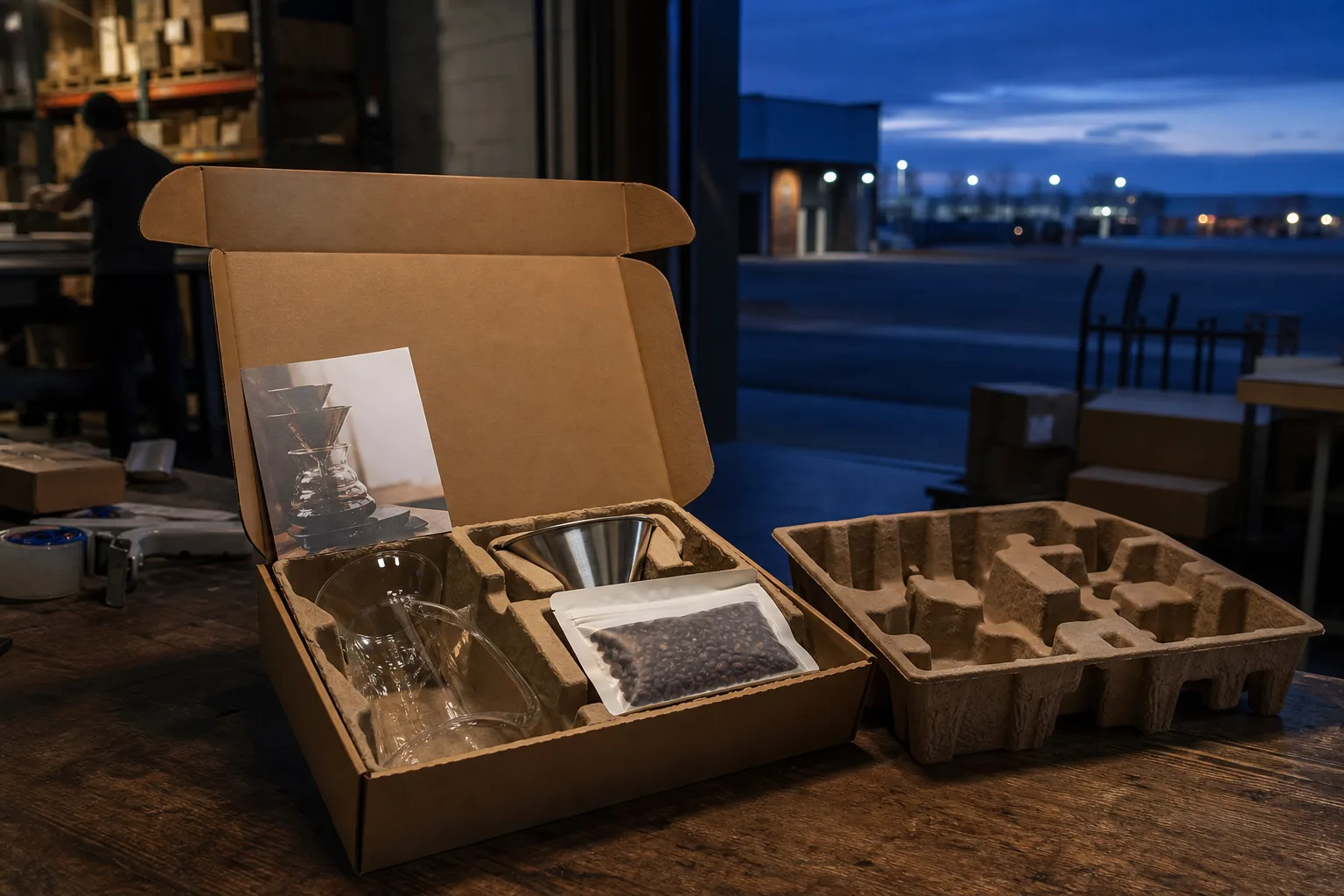
Consider a single product: a pour-over coffee set sold as one item at one price, made up of a glass carafe, a steel cone, a twelve-ounce bag of roasted beans, two filters and a printed card. The customer buys one thing. The warehouse holds five. Somewhere between those two facts sits a set of decisions about how the pieces are combined, who combines them, and what happens when the carafe arrives in pieces. Most sellers never look at those decisions until the third broken-arrival email of the month, by which point the packing pattern has already been repeated a few thousand times.
Kitting, and what the word commits you to
Kitting means assembling several separate stock items into one sellable unit before an order exists, so that picking is a single action rather than five. The trade calls the recipe a bill of materials, or BOM: the list of components, their quantities, and the order they go into the box. Once a kit is built, it usually gets its own SKU, which is the stock number the system picks against. That matters more than it sounds. The moment the kit has its own SKU, the components stop being separately countable in most inventory reports, and a shortage of filters shows up as a shortage of coffee sets.
The alternative is to kit on demand, assembling at the moment the order drops. That keeps components flexible and avoids stranding beans inside a kit that stops selling, but it slows every pick and multiplies the chances that someone forgets the card. Preassembly is faster and more consistent and commits inventory early. Neither answer is right in the abstract. It depends on how fast the kit sells, how perishable the contents are, and whether the components also sell on their own. Written down as a choice, it is easy. Discovered in November, it is not.
Where the carafe actually breaks
Glass in a mixed kit rarely breaks because the box was dropped. It breaks because the bag of beans, which is soft and heavy and settles during transit, stops supporting the carafe somewhere in Ohio, and the carafe then has room to move against the steel cone. The industry word for the material that prevents this is dunnage, which covers everything from molded pulp trays to air pillows to corrugated inserts. Void fill is the loose version: paper or air that occupies space without positioning anything. Those two are not interchangeable, and treating them as if they were is the single most common cause of a damage rate that nobody can explain.
A molded insert costs more per unit and holds each component in a fixed position regardless of orientation. Loose fill costs less and allows migration. The trade tests the difference with drop and vibration sequences modeled on parcel handling, and a packaging engineer will talk about these in terms of distribution cycles rather than guesses. The useful question to ask a contract packer is not whether the box is sturdy. It is whether the heaviest component can reach the most fragile one if the carton is shaken on its side for an hour.
Carrier liability is narrower than people assume
When the carafe arrives broken, the instinct is to file with the carrier. Parcel carriers limit their liability to a declared value, typically a modest default amount unless a higher value was declared and paid for at the time of shipment, and they exclude damage caused by insufficient packaging. That exclusion does the real work. A denied claim rarely says the carrier was careless and is refusing anyway; it says the packaging did not meet the carrier's published standard, which shifts the loss back to whoever packed the box. For freight moving on a pallet, the bill of lading and the carrier's tariff govern, and the limits are usually stated per pound rather than per shipment.
Concealed damage is the term for breakage discovered after the carton is opened and signed for clean. Most carrier tariffs give a short window to report it, often measured in days, and they put the burden on the claimant to show the damage happened in transit rather than before pickup or after delivery. Photographs of the outer carton, the inner packing as found, and the broken item together are what satisfy that burden. A photograph of the carafe alone on a kitchen counter almost never does, because it proves breakage without proving when.
Who carries the loss, in order
The sequence is usually this. The seller refunds or replaces for the customer, because the customer's contract is with the seller and the carrier's limits are irrelevant to that relationship. The seller then tries to recover from the carrier, succeeding when the packaging met standard and failing when it did not. If a third-party warehouse built the kit, the contract between seller and warehouse decides what happens next, and the clause that matters is the one defining responsibility for packaging specification. Many agreements say the warehouse packs to the client's specification, which means the warehouse is liable for following the spec and the client is liable for the spec being wrong.
That distinction is worth settling in writing before the first season rather than after it. Providers offering kitting fulfillment services will often help develop the pack-out, run a sample through a drop sequence, and document the result, and a documented specification is what converts a vague argument into a short one. Labeling obligations sit alongside this: net contents and package declarations fall under weights and measures standards that the National Institute of Standards and Technology is responsible for, and a kit sold as a single unit still has to state what is inside it accurately.
The everyday consequence people rarely trace back is the return rate on a product that is otherwise selling well. A kit with a four percent breakage rate does not look like a packing problem from the sales dashboard. It looks like a quality complaint, a reviews problem, a customer service cost, and eventually a reason to discontinue a product that was fine. The cause was a tray that was never specified.
Before the next production run, pull one kit off the shelf, open it, and shake the closed box hard enough to be slightly embarrassing. Whatever moves is the thing that will arrive broken, and fixing it now costs a few cents per unit instead of a replacement plus freight plus the message.