Free Photos, Paid Reports. What Evidence Actually Costs, and Which Parts Hold Up
In a dispute, the cheapest evidence is the photo you already took and the most persuasive is usually a number a second person can reproduce. Here is what sets the price.
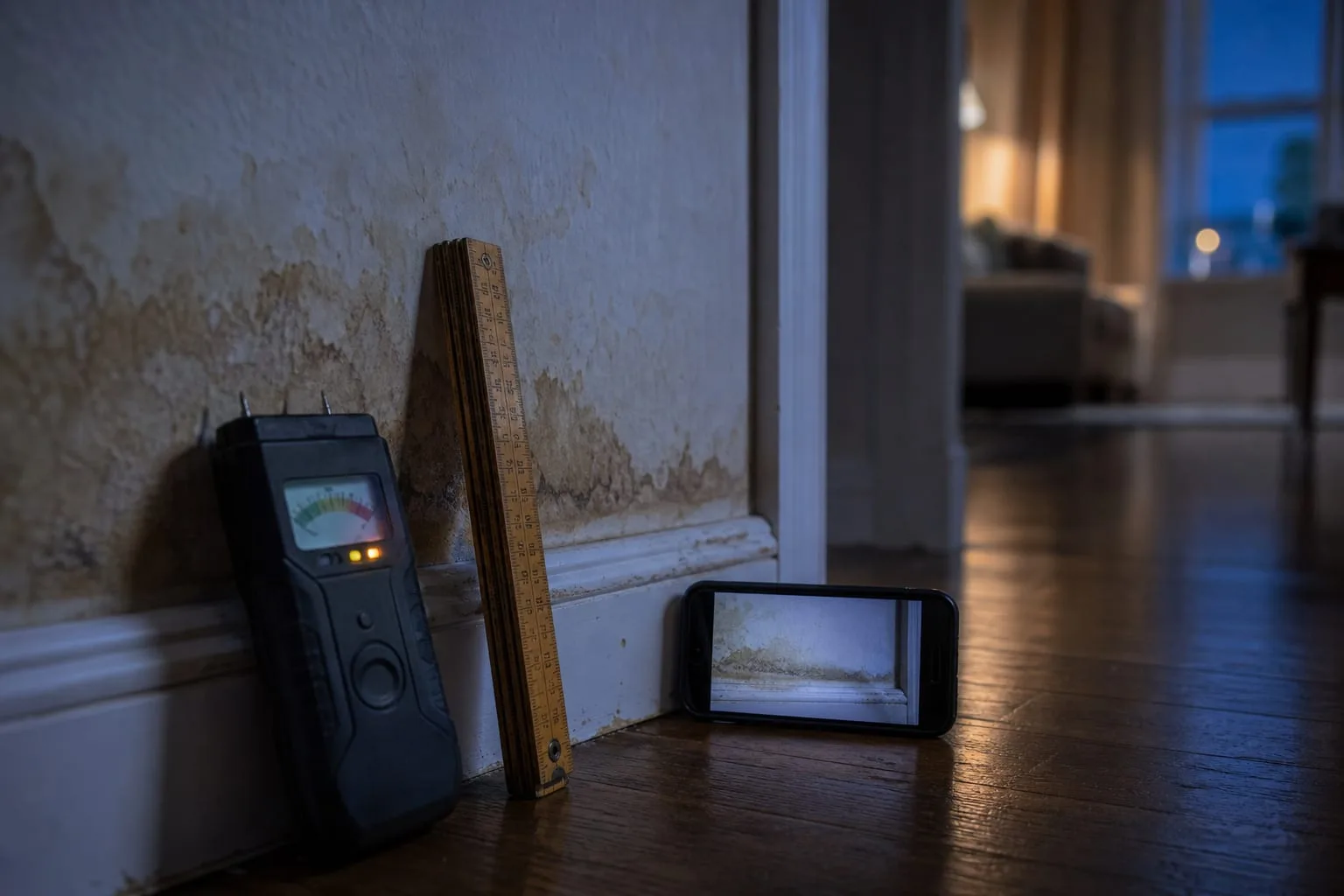
The first thing most people bring to a dispute is a phone full of pictures, and the first thing that happens to those pictures is that somebody on the other side looks at them and says they are inconclusive. That is often a fair reading. A photograph of a stain records that a stain existed on the day the shutter fired, at an unknown scale, in unknown light, at an unknown moisture content. It is free to produce and cheap to argue with. The evidence that survives an argument almost always costs money, and the amount it costs is set by a handful of specific variables worth knowing before you spend.
The difference between a glance and a tape measure
Evidence holds up when a second person, working independently, arrives at the same number. That is the whole test, and it explains why descriptions lose to measurements in nearly every forum: an adjuster's file, a licensing board complaint, a small claims hearing, a mediation. "The floor slopes" is a glance. "The floor drops eleven sixteenths of an inch over eight feet, measured at three marked locations" is a measurement, and it carries a quiet threat, which is that anyone who doubts it can go and check. Moisture percentages, elevations, crack widths, decibel readings, temperature differentials across a wall. These are the dimensions that set both the credibility and, as it turns out, the price.
What makes a measurement expensive is not the instrument. Moisture meters and laser levels are inexpensive and a determined homeowner can learn to use one properly in an afternoon. The cost is in the person who signs the number, because a signature carries a license, an insurance policy, and an obligation to defend the reading if challenged. That is the line the money crosses. You can buy the reading for very little and the defensible reading for a great deal more, and choosing between them is the first real decision in any dispute.
What changed, and why your own photographs now need help
Two shifts have landed in the past few years and both cut against the casual snapshot. The first is doubt about images generally. Once ordinary software could generate a convincing photograph of a thing that never existed, the unspoken assumption that a picture is a record of an event stopped being safe, and the people evaluating claims adjusted accordingly. The response has been provenance: embedded credentials and cryptographic signing that travel with a file and record where it came from and what was done to it. The National Institute of Standards and Technology is the federal body responsible for measurement standards and for a good deal of the work on digital media authenticity, and the direction of travel is toward files that can prove their own history.
The second shift is retention. Doorbell cameras, security systems, and building access logs keep footage for a window that is often measured in days rather than months, and that window is set by a subscription tier chosen years ago and forgotten. The practical consequence is that the cheapest strong evidence in most household disputes has an expiration date. Downloading the clip on day two costs nothing. Reconstructing what happened after the clip has rolled off costs an expert, and sometimes cannot be done at all. Speed is now a cost driver in its own right.
Where the money actually goes
Price sorts into roughly four tiers, and they are separated by multiples rather than percentages. At the bottsom sits everything you generate yourself: dated photographs with a ruler or a coin in frame for scale, a written log kept as things happen, saved texts and emails, an original contract, the downloaded video. Cost, effectively zero. Next comes the inspection report, produced by a home inspector, an industrial hygienist, a roofer, or a plumber, describing conditions and attaching photographs and readings. This typically lands below the cost of a couple of hours of an attorney's time, and for most residential disputes it is the highest value purchase available.
Above that sits the engineer's or licensed specialist's opinion, stamped, addressing causation rather than condition, and priced at several multiples of the inspection. Causation is the expensive question because answering it means eliminating alternatives, which means more site time, sometimes destructive testing, and a written analysis the author is prepared to defend. At the top sits testimony, priced by the half day or day, plus preparation. Most disputes are settled somewhere in the second tier, which is worth knowing before anyone spends into the third.
The dimensions that set the price
Scope drives the invoice more than anything else. An inspector asked to evaluate one bathroom quotes one number; the same inspector asked to evaluate a whole house because nobody narrowed the question quotes something considerably larger, and the report comes back diluted. Square footage matters for surveys and thermal work. Access matters, because crawlspaces, roofs above two stories, and anything requiring a ladder or a lift add hours. Deadline matters, since a report needed in four days is priced differently from one needed in three weeks. And the intended audience matters most of all: a report written for your own information is a different document, at a different price, from one written knowing the other side's expert will read it and try to reproduce every figure in it.
The economical move is to sequence the spending. Preserve the free evidence immediately, including the footage that is about to expire, then buy one narrowly scoped report on the single factual question the dispute actually turns on. Nine times out of ten that report either resolves the matter or tells you clearly whether the next tier is worth buying. Spending in the other order, expert first and preservation later, is how people end up with a stamped opinion resting on photographs nobody can date.
Write down the question you need answered in one sentence before you call anyone. If it contains the word "why," you are shopping in the causation tier and should expect the price that goes with it. If it contains "how much" or "how far," you are buying a measurement, and a measurement bought early tends to be the cheapest thing in the file and the hardest for anyone to move.