Five Things to Check Before a Cleaning Company Quotes Your House, Starting With Who Measured It
A window that sticks, a streaked wall, a rotted board: the measurements behind a maintenance quote decide more of your year than the hourly rate does.
A sash that has to be shoved to open, a gray stripe running down the siding under one corner of the roof, a downspout that gurgles and then spills over the top in a heavy rain: these are usually filed under the house getting old. More often they are the visible end of a maintenance interval that quietly stretched from twelve months to thirty. When people finally hire out the work, they compare hourly rates, which is the one number that tells them almost nothing. The figures that set the price, and the outcome, are dimensional.
1. The number the price is built on, and who took it
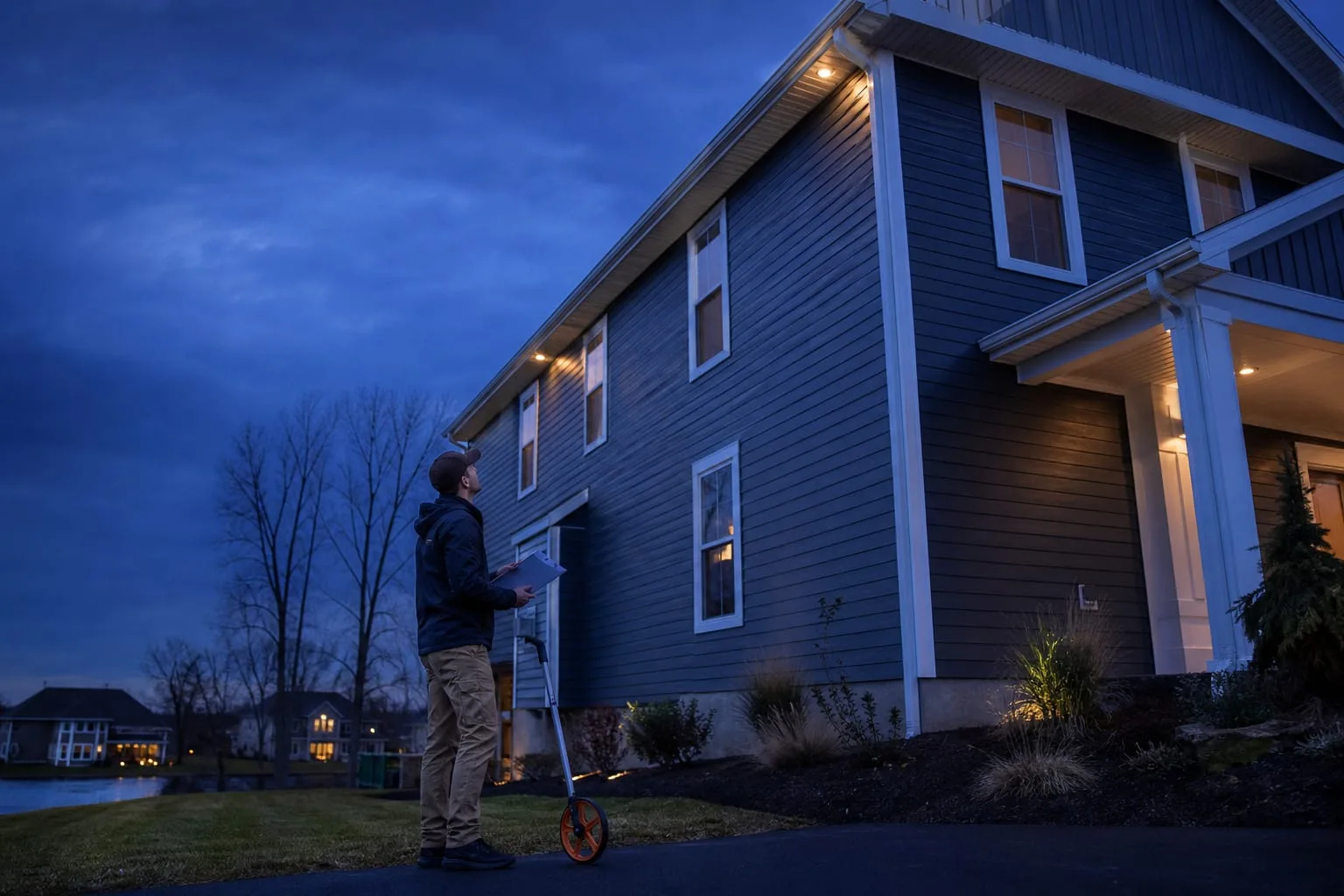
Every recurring exterior job is priced off a measurement: linear feet of gutter, squares of roof, panes of glass counted as individual lites rather than as windows, feet of duct run, square footage of hard surface. A firm working from aerial imagery and a county record is estimating from a glance. A firm that walked the perimeter with a wheel has a number it will stand behind. Ask which figure your quote is built on, and ask what happens on the day if the crew finds forty more feet than the file says. The answer separates a fixed price from an opening bid.
The gap is rarely small. Bay windows, a dormer, an added sunroom and a detached garage with its own gutter run all sit outside the tidy rectangle a satellite image suggests. Larger providers tend to have a measurement step built into the sales visit precisely because their crews are paid by production and a bad estimate costs the company, not the homeowner. That alignment is worth asking about directly. When the person quoting has to live with the number, the number gets taken carefully.
2. Height, pitch and access, which cost more than area
Two houses with identical gutter footage can differ by half in price, and the difference is almost never the gutters. It is the second story, the roof pitch steep enough that nobody walks it, the mature hedge that keeps a ladder from setting its feet, the gate too narrow for a wheeled machine, the hose bib eighty feet from the work. The Occupational Safety and Health Administration is responsible for fall protection standards covering work at height, and a company with employees on the roof carries that obligation as a real line in its cost structure. That is part of why a firm prices a walkable ranch and a steep colonial so differently.
Measure the access before you invite bids, because it makes the quotes comparable. Note the number of stories on each elevation, the approximate pitch, where a ladder can and cannot stand, the width of the narrowest gate, and the distance from the nearest spigot and outlet. Hand the same page to everyone. The estimates that come back will differ on scope rather than on assumptions, and the outlier will be obvious.
3. Who actually arrives, and under whose insurance
Ask whether the crew is on payroll or subcontracted, and ask for the certificate of insurance with general liability and workers' compensation both showing. This is not paperwork for its own sake. If an uninsured worker falls off your fascia, the claim can find its way to your homeowners policy, and that is a consequence almost nobody traces back to the day they chose the cheaper bid. A larger organization usually carries both coverages as a condition of the commercial accounts it also services, and can produce the certificate the same afternoon.
Continuity matters for a second reason. A crew that has been to the property before knows which downspout backs up, which screen is brittle, which section of trim was already soft last spring. Companies with more than a few trucks can keep a property file and route the same team to it, and can still cover the visit when someone is out sick. A solo operator can be excellent and often is, but a single flu week in October is the difference between a cleaned gutter and an ice dam.
4. Where the scope actually stops
Most disputes in cleaning and upkeep live at a boundary somebody assumed and nobody wrote down. Are downspouts flushed with water, or are the troughs scooped and the outlets left as they were. Is debris bagged and hauled, or piled behind the shed. Does window work include frames, tracks and screens, or glass only. Is hard water spotting from a lawn sprinkler treated, or excluded as a mineral deposit. That last one has a slow consequence: mineral deposits left on glass through several summers etch it, and the fix is a replacement sash rather than a bucket.
Get the exclusions in writing, in the same document as the price. Good companies keep a standard scope sheet and will hand it over without being asked, because it protects their crews from being drawn into unpaid extras. Read it for what is absent as much as for what is listed. Then decide what you want added, and price it once rather than negotiating it in the driveway.
5. The record the visit leaves behind
The most useful thing a maintenance contract produces is a dated history. Photographs before and after, a note on what was found, the next recommended interval based on canopy and season rather than on a generic calendar. That file is what you hand an adjuster when a claim turns on whether the property was maintained, and what a roofing warranty administrator wants to see. Larger providers keep this because their scheduling software already does, and it costs you nothing to ask that the report be emailed rather than left on a door hanger.
Take the measurements yourself first: footage, stories, pitch, pane count, gate width. An hour with a tape and a notebook converts three quotes from three opinions into three prices for one defined job, and the year that follows is quieter for it.