First House, First Year? The Maintenance Words That Decide Who Pays Later
Wear and tear, ensuing loss, proof of maintenance: the terms in your policy and warranty documents each commit you to something specific, and a first-timer can meet all of them cheaply.
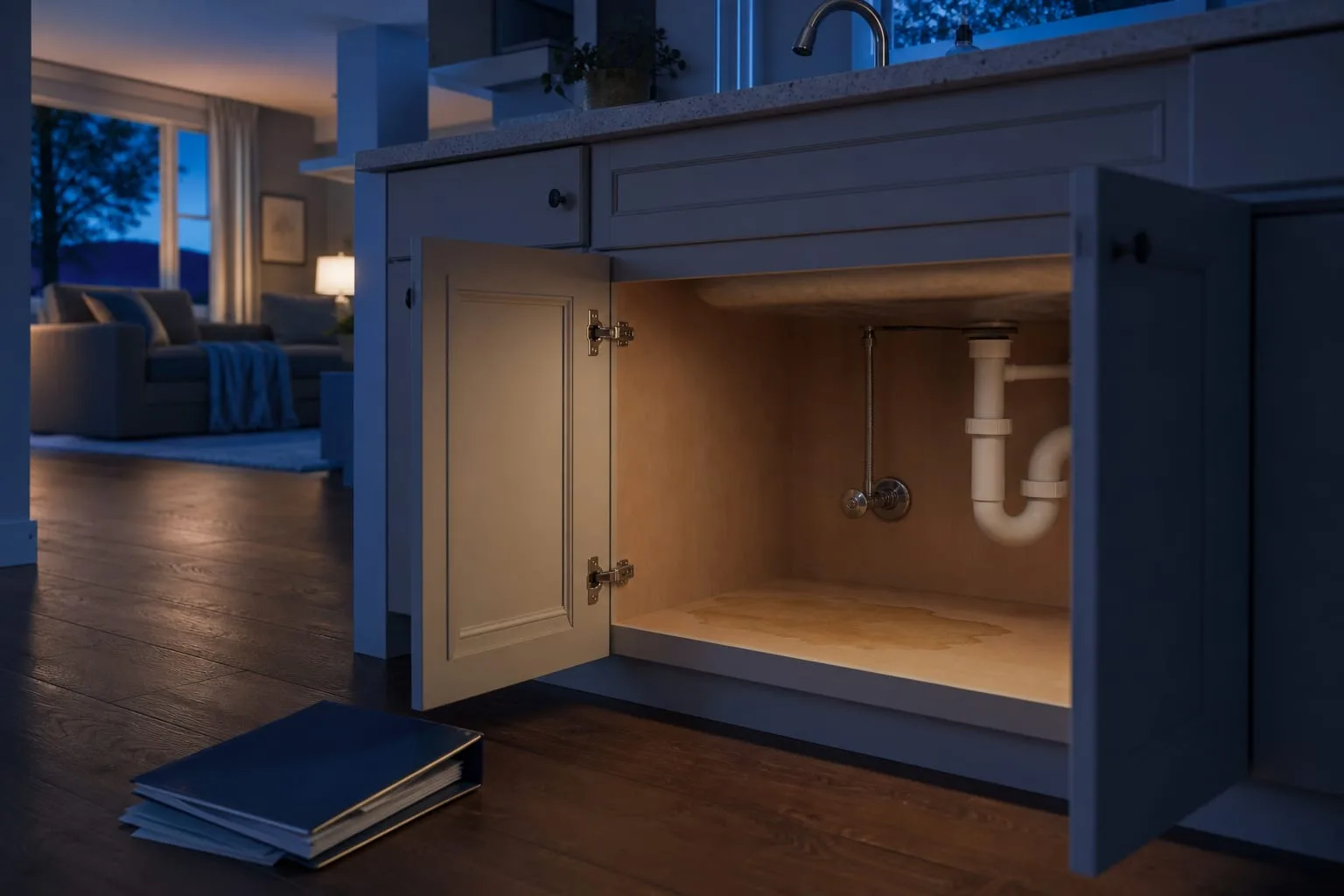
The first year in a house is mostly small decisions about things that are not yet problems. A slow drip under a sink, a downspout that discharges two feet from the foundation, a water heater whose anode rod nobody has looked at since installation. None of these is urgent, and none of them will announce itself. What makes them worth attention now, before anything has failed, is that the documents already in your filing cabinet, the homeowners policy and the manufacturer warranties, use a specific vocabulary to divide damage into the kind they pay for and the kind they treat as yours.
Wear and tear, gradual deterioration, and the sudden event
Almost every homeowners policy carves out damage that developed slowly. The phrases vary a little between carriers, but the family of terms is consistent: wear and tear, deterioration, latent defect, and continuous or repeated seepage or leakage over a period of weeks or months. What each of these commits you to is the same thing, stated four ways. The policy is buying you protection against events, not against the passage of time. A supply line that bursts at two in the morning is an event. The same line weeping into a cabinet since March is, in the carrier's reading, a maintenance item that you had the opportunity to notice.
The term that runs the other direction is ensuing loss, sometimes written as resulting loss. It means that when an excluded cause produces a separate covered event, the second event may still be paid. A corroded fitting is excluded; the water that escapes when it finally lets go may not be. First-timers often read the exclusion, conclude the whole claim is dead, and never file. Read the sentence that follows the exclusion before you decide, because that is usually where the ensuing loss language sits, and it is the part that determines whether a call to the carrier is worth making.
What a warranty asks of you, and what it cannot ask
Appliance and system warranties add a second layer of obligations, and they are more specific than the policy. A furnace warranty may condition the heat exchanger coverage on annual inspection by a licensed contractor. A tankless water heater may require descaling at a stated interval in hard water. A roof warranty distinguishes between the material warranty from the manufacturer and the workmanship warranty from the installer, which are separate promises with separate durations and separate people to call. Registration is its own trap: some warranties shorten coverage substantially if the product is not registered within thirty or sixty days of installation.
There is a limit on what those conditions can demand. The Federal Trade Commission is responsible for warranty disclosure rules on consumer products, and the long-standing principle is that a company generally cannot void your warranty simply because you used an independent servicer or a third-party part, unless it supplies that part or service free of charge. The practical translation for a first-time owner is that you may use your own plumber and your own filters. What you cannot skip is the maintenance itself, or the paper that shows it happened.
Proof of maintenance is a document, not a memory
Proof of maintenance is the phrase warranty administrators and adjusters use, and it means something narrower than most people assume. A credit card line reading "HVAC" proves a payment. What satisfies the desk is an invoice showing the date, the address, the company name and license number, the model and serial number of the equipment, and a description of the work performed. Ask for that on the invoice at the time of service, because getting it reissued eighteen months later, from a technician who has moved on, is a project. Photographs with visible timestamps do useful supporting work, particularly of gutters, crawl spaces, and water heater pans.
Keep the record in one place, organized by system rather than by date, so that each unit has its own short history: purchase, installation, registration, and every service call. Six items is a realistic first-year set for most houses. Heating and cooling, water heater, roof and gutters, sump pump if you have one, dryer vent, and the exterior grading and drainage. That folder is the difference between a claim conversation that takes ten minutes and one that takes three weeks of retrieval.
Setting the intervals from the documents, not from habit
Once the paperwork is assembled, the maintenance calendar mostly writes itself, because the intervals are already stated somewhere. Take each warranty and each policy condition and copy the required frequency onto a single sheet with the month it comes due. Where nothing is specified, the manufacturer's installation manual usually is, and it is often available as a PDF from the model number alone. Anything not named in a document is discretionary, and can be scheduled around your budget rather than around a deadline. That distinction, between required and merely advisable, is what keeps a first year from feeling like an unbounded list.
Small neglect compounds because the cost of the repair rises while the coverage available for it falls, and those two curves cross quietly. The documents that govern that crossing were written before you moved in, and they will be read literally when the moment comes. Reading them first, in October, with a pen, costs an afternoon.