Fans Still Running on Day Five? What the Daily Readings Have to Prove Before They Come Out
Drying is finished when materials hit a documented moisture target, not when the surface feels dry or the rental clock looks expensive.
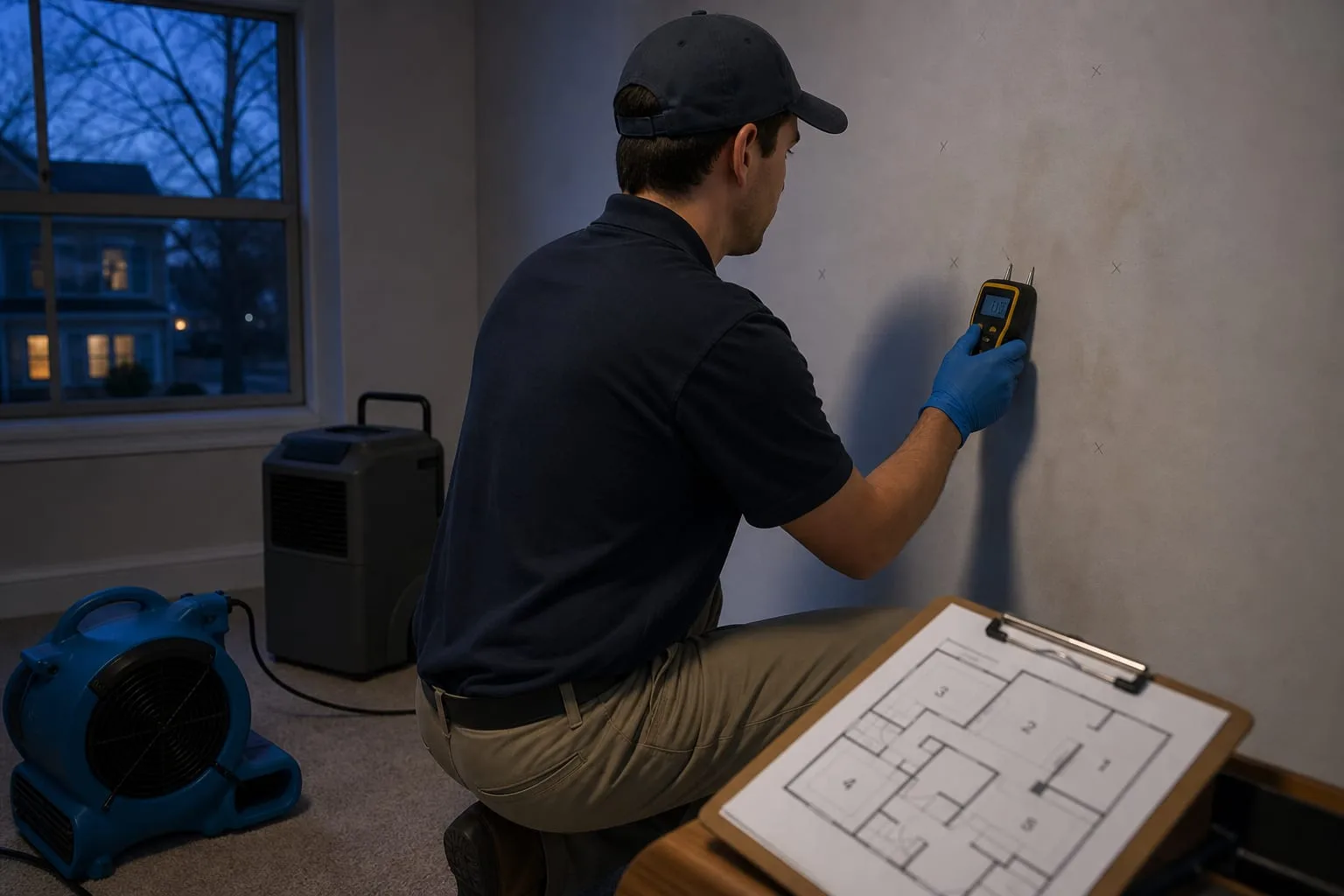
A hand on a baseboard tells you almost nothing. The paint film dries first, the surface of the drywall dries next, and the paper backing, the framing, and the sill plate underneath it dry last, sometimes by a week. That gap between what a glance reports and what a pin meter reports is where most drying disputes start, because the homeowner is standing in a room that feels fine while three air movers are still running and the rental line on the invoice keeps growing. Both parties are describing the same wall accurately. They are measuring different things.
The assumption is that drying is a race, and the equipment count is the speed
Most people arrive at a water loss believing the job is to move as much air as possible for as long as it takes, and that more fans mean a shorter job. Air movement is one of four variables, and on its own it is the least useful of them. Evaporation depends on how much water is in the material, how warm that material is, how much moisture the surrounding air is already holding, and how fast that air is being replaced at the surface. Add fans to a sealed room with saturated air and you get noise, a higher electric bill, and moisture that lifts off the floor and lands on the ceiling.
The dehumidifier is the part of the setup that actually removes water from the building. The air movers only present wet surfaces to dry air faster than still air would. That is why a competent technician will sometimes turn fans off, or move them, rather than add them: once the air in the containment is close to saturation, further evaporation has nowhere to go. The measurement that governs this is the difference between how much moisture the air holds and how much it could hold at that temperature, and it is checked with a meter, not by feel.
What the daily visit is actually made of
The week-to-week reality of a drying job is unglamorous and largely clerical. Someone arrives, usually in the morning, and takes the same readings in the same places they took them yesterday: temperature and relative humidity outside, in the affected rooms, in an unaffected room, and at the dehumidifier's discharge. Then they take moisture content readings at marked points on the drywall, the subfloor, the framing, and whatever else got wet, using either a pin meter that measures resistance between two probes driven into the material or a non-invasive meter that reads a shallow depth without leaving holes.
Those points are marked because a reading is meaningless unless it is the same spot as the last one. Moisture in a wall is not evenly distributed, and a technician who wanders six inches to the left each day can produce a graph that shows anything they want. Good documentation looks boring: a floor plan with numbered locations, a date, a number, and the equipment that was running when it was taken. That record is what the adjuster reads, what the invoice is defended with, and what tells everyone whether the job is progressing or has stalled.
The visit itself is often fifteen minutes. Most of the drying happens in the twenty-three and a half hours when nobody is in the house, which is why the equipment is left running continuously and why unplugging a loud fan overnight quietly resets the previous day's progress.
The number that ends the job is a comparison, not a threshold
There is no universal figure at which wood is dry. A framing member in a Phoenix house in June and the same member in a Minneapolis basement in March sit at different equilibrium moisture contents, both perfectly normal. So the target is set by comparison: readings are taken from the same material in an unaffected part of the same building, and that becomes the dry standard for this job, in this house, this week. The affected materials are dried until they reach that number or come within a defined margin of it, and stay there.
This matters for the reader watching the calendar, because it explains why two jobs that look identical run three days and eight days. Plaster over wood lath holds water differently than half-inch drywall. Engineered flooring over a slab dries from one side only. A wet cavity behind kitchen cabinets has no easy path for air unless holes are drilled, and the decision to drill is a decision to spend an hour now instead of four days of equipment later. Those are the dimensions that set the duration and therefore the price, far more than the square footage anyone quotes.
Why the fast version costs more later
Drywall pulled tight against a wet stud can read acceptably on the face while the framing behind it is still well above the dry standard, and if the equipment leaves on that basis, the moisture redistributes, the finish is put back, and the problem reappears as a stain or an odor six weeks on. The second visit is not a repeat of the first. It now includes demolition of new work, and the insurance conversation is harder because the initial claim has been closed and paid. The Environmental Protection Agency is the federal body responsible for guidance on indoor moisture and mold, and its consistent position is that the water has to be removed and the material dried, not merely covered.
The favorable version of this is that the whole thing is decidable in advance. Ask, on day one, what the dry standard is for each material, where the monitoring points are, and what readings will end the job. A firm that measures will answer in numbers within a minute. A firm that guesses will answer in days.
What to do with the readings you are handed
Keep every daily sheet, and read across the dates rather than down the column. What you want to see is a curve: sharp drops in the first day or two, then a flattening as the material approaches the standard. A flat line from the beginning means the setup is not working and something needs to change, usually the dehumidifier's capacity or a cavity that has not been opened. Two consecutive flat days is the reasonable point to ask what is being adjusted, and that question, asked politely on day three, tends to shorten the job more than any fan ever does.
Photograph the meter display next to the marked location if you want your own record. It costs nothing, it takes a few seconds during a visit you are already present for, and it converts a disagreement about whether the wall felt dry into a disagreement about two numbers, which is a much easier conversation to finish.
The equipment comes out when the readings say so. Everything else is a guess wearing a schedule.