Fall Upkeep and Nobody Gives You a Straight Answer? The Log, the Photos and the Questions
Autumn turns small household neglect into a bill you pay in February. A dated log, a few cheap tools and four blunt questions keep the compounding from starting.
The week the clocks go back is when most households discover what they did not do in July. Gutters that ran fine through summer rain back up under wet leaves, a furnace that sat idle for six months comes on smelling of dust, and a hairline gap in the caulk around a north-facing window starts admitting cold air that shows up on the next bill. None of this is dramatic. That is precisely the problem: the season converts things nobody noticed into things nobody can price, and by the time a number appears it has usually been growing for two or three years.
What the season actually changes about neglect
Deferred maintenance is not a constant. It compounds in cold and wet, because water that would evaporate in August sits, freezes, expands and finds the next weakness. A clogged downspout in June is an inconvenience; the same downspout in January sends water against a foundation wall repeatedly, freezing overnight and thawing by afternoon. Heating equipment behaves the same way, since a restricted filter that cost nothing in summer makes a blower work harder every hour of every day for five months. The season does not create the neglect. It puts it on a meter.
The practical consequence is that October and early November are the only weeks in the year when a small correction still buys a whole season. Clear the gutter and the freeze-thaw cycle has nothing to work with. Replace the filter, check the flame, seal the two windows that whistle, and the heating system spends the winter doing what it was sized to do. Wait until February and you are no longer maintaining anything; you are responding, at a time when every contractor in your county is booked and pricing accordingly.
Two pieces of paper that carry most of the weight
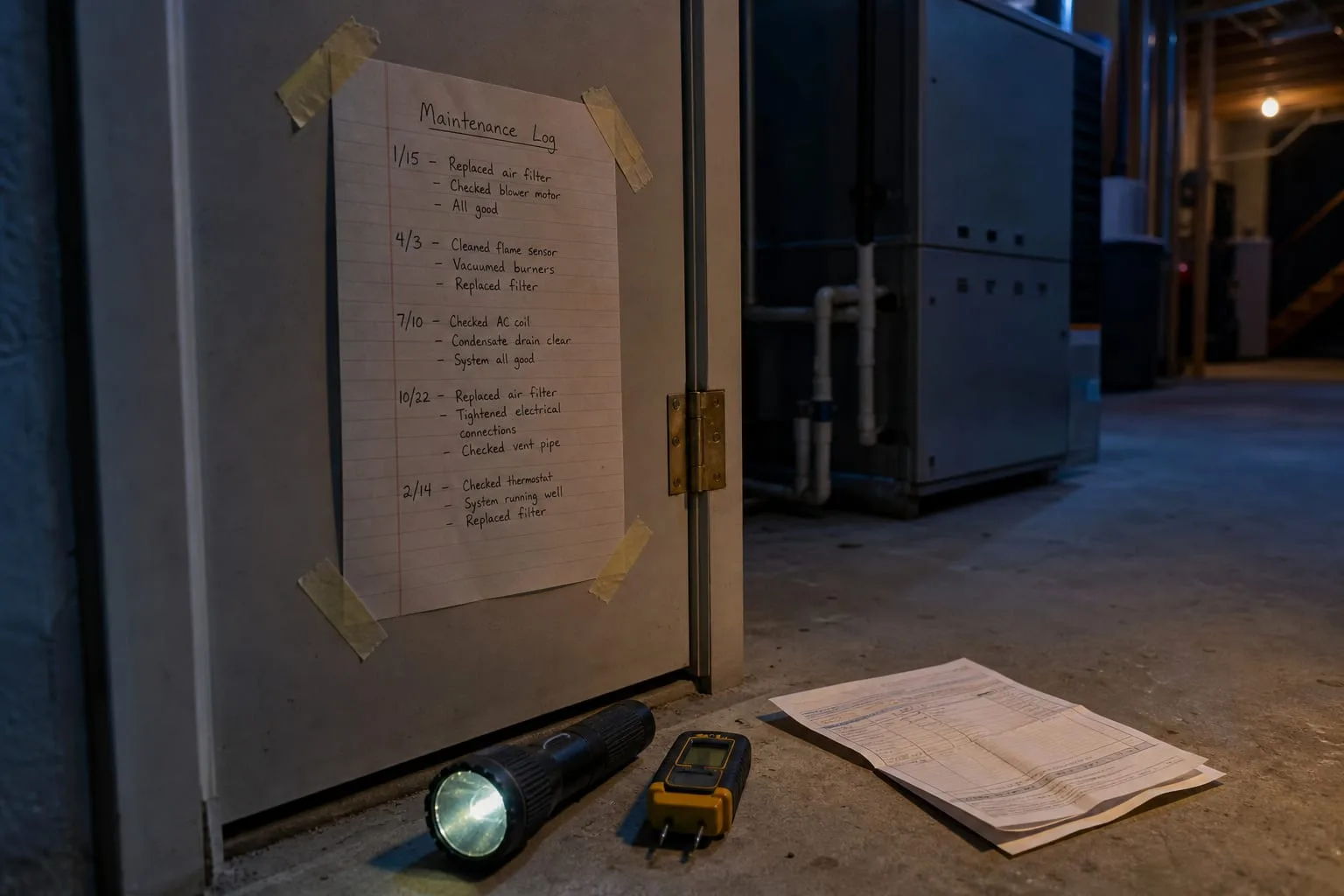
The first is a dated log, one page, kept where the equipment is rather than in a drawer upstairs. Each line needs four things: the date, what was done, who did it, and the next date it comes due. Filter size goes at the top, because that single number, written once, ends years of standing in a hardware aisle guessing. A log makes patterns visible that memory hides. Three service calls on the same zone valve in eighteen months is an argument for replacement, and it only reads as an argument if the dates are written down.
The second is a folder of invoices, receipts and any warranty registration you completed. Manufacturers routinely condition warranty coverage on documented annual service, and homeowners insurance adjusters ask, in their own way, whether a loss was sudden or the end result of something you had been living with. Neither conversation goes well from memory. A folder with an annual service invoice in it converts a disputable claim into a documented one, and it converts a vague argument with a manufacturer into a short one. Keep the folder physical or scanned, but keep it in one place.
The tools worth owning before the first freeze
The list is short and none of it is specialized. A bright flashlight, because almost every early sign of trouble lives in a place with no light: the crawlspace, behind the water heater, the back corner of a closet on an exterior wall. An inexpensive moisture meter, which turns the question of whether a stain is old or active into a reading rather than an opinion. A furnace filter or two in the right size, bought in advance. Your phone, used deliberately, with a photo of every meter, panel, model plate and serial number stored somewhere you can find it.
Photographs are the underrated tool, because they are dated automatically and they answer the one question every dispute turns on. Shoot the same six or eight views each fall: the roof edge from the ground on all sides, the foundation where the downspouts discharge, the basement corners, the water heater base, the area around the washing machine hoses. It takes ten minutes. A year later you can tell, without argument, whether that ceiling ring grew. The Department of Energy, which oversees residential energy use and equipment efficiency standards, treats seasonal servicing of heating equipment as ordinary practice rather than an upgrade, and the paperwork is what proves you followed it.
Four questions for the person in your basement, and what a weak answer sounds like
Ask what specifically was measured, and expect numbers. A technician who says the system is running fine has told you nothing; one who tells you the temperature rise across the heat exchanger, the static pressure, or the reading on the flame sensor has done work you can compare next October. Ask what the failure looks like when it comes, and by roughly when. Ask what it costs to address now against the cost after it fails, since the ratio is the entire decision. Ask, finally, what goes in writing on the invoice.
A poor answer is one that cannot be checked later. Vague reassurance, refusal to put a recommendation on the invoice, urgency without a mechanism, or a price quoted only as a monthly payment are all versions of the same evasion. Good answers name the part, the reading and the date. Ask for the recommendation to be written on the invoice even when you decline the work, because a declined recommendation with a date on it is useful in two directions: it tells next year's technician what was already seen, and it tells you when the clock started.
The week-to-week version, which is the one that survives
A seasonal checklist done once in a burst tends not to repeat. A twenty-minute rotation does. One weekend the gutters and downspout discharge, the next the basement and crawlspace walk with the flashlight and meter, the next the filters and the visible plumbing connections, the next the exterior caulk and the door sweeps. Four Saturdays covers the house, and then it starts again. Write the date on the log each time, even when nothing was wrong, because a line that reads clear is the record that makes next year's reading mean something.
By late November the log has five or six entries, the folder has an invoice with numbers on it, and the photographs sit dated on your phone. What that buys is not a house in perfect repair. It is the ability to tell, in the middle of a January problem, exactly what was seen in October and who saw it.