Equipment Gone in Three Days? How to Tell Drying Done Right From Drying Done Fast
Restoration crews use a vocabulary of drying goals, grain depression and equipment days. Here is what each term commits you to, and what a good job looks like from the sofa.
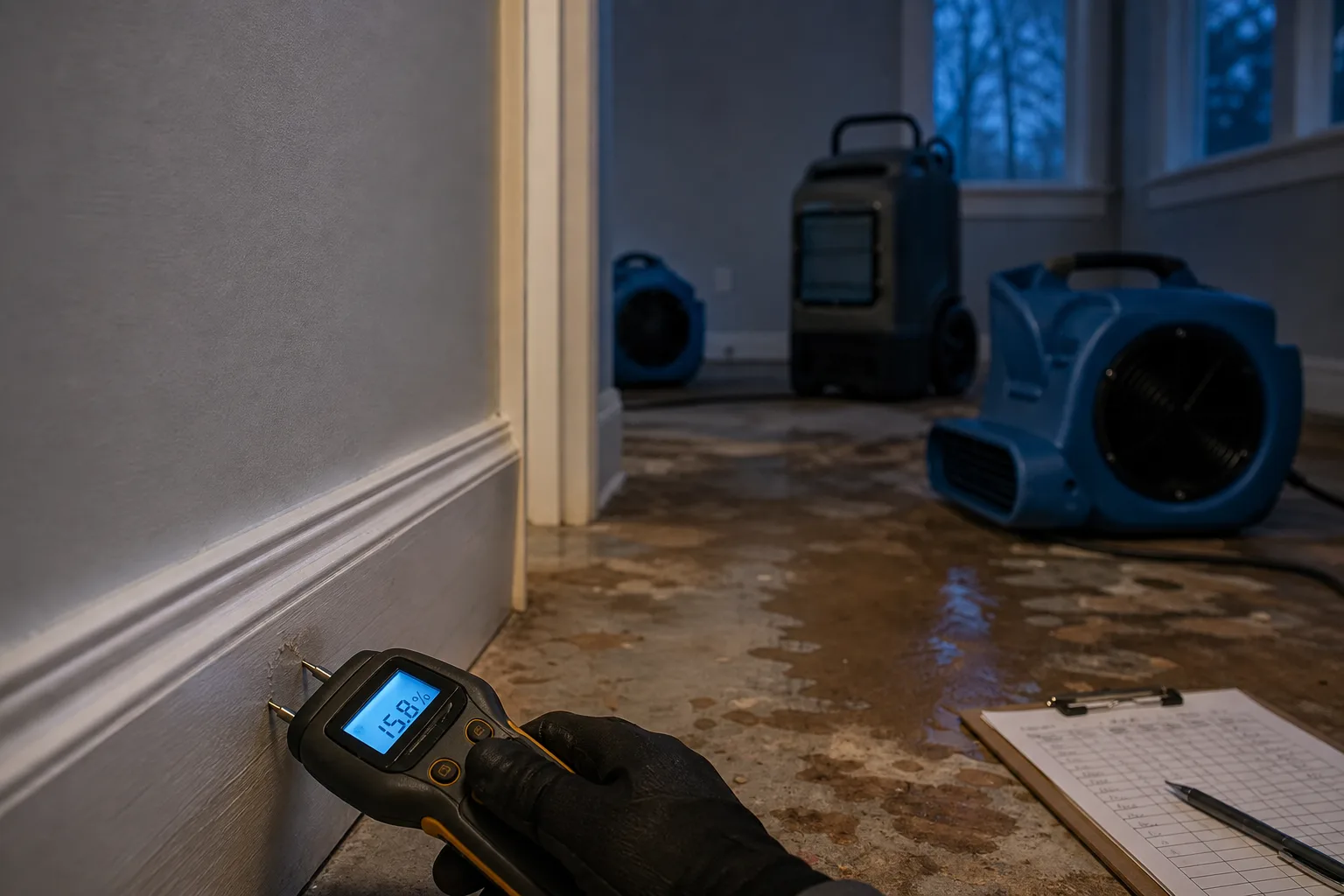
The loudest part of a water loss happens in the first day, and the part that decides whether you have a problem next spring happens quietly over the four or five days after. A crew arrives, pulls pad, sets fans, and leaves behind a row of machines that make conversation difficult and the electric meter spin. Then, at some point, somebody decides the house is dry and takes the equipment away. That decision is the job. Everything before it is setup, and almost everything a homeowner worries about during the week is really a worry about whether that call will be made honestly.
A drying goal is a number, not an opinion
Before the first air mover goes down, a competent technician should establish what the trade calls a drying goal: a target moisture reading taken from unaffected material of the same type elsewhere in the house. The baseboard in a bedroom that never got wet tells you what dry oak baseboard measures in your house, in your climate, this month. That reading becomes the finish line. Without it, dry means whatever the person holding the meter wants it to mean on the morning the equipment is needed at another job. Ask on day one what the goal number is and which room it came from.
You will also hear category and class. Category describes what was in the water, running from clean supply line water through gray water from an appliance to contaminated water from sewage or a river. Class describes how much material got wet and how hard it will be to dry, which drives how much equipment is warranted. Those two words set the entire scope: they decide whether carpet pad can be dried in place or has to go in a bag, whether drywall is cut, and whether the work needs containment and negative air. A crew that says both out loud, early, is working from the industry's written standard rather than from habit.
Reading the meter the way the technician does
There are two instruments on the truck and they answer different questions. A non-penetrating meter reads moisture through a surface without marking it, useful for sweeping a floor to find where the water traveled, and it is a mapping tool rather than a verdict. A pin meter, which leaves two small holes, measures moisture content inside the material and gives the number that counts against the drying goal. If every daily reading in your file came from the non-penetrating tool, the crew mapped the loss carefully and then declared it dry by inference. The distinction sounds technical. It is the difference between a documented result and a guess.
The other number worth knowing is grain depression, which is the gap between how much moisture the air holds going into the dehumidifier and how much it holds coming out, measured in grains per pound. A healthy gap means the machine is actually pulling water out of the room rather than running as an expensive heater. Low-grain refrigerant dehumidifiers work well in ordinary conditions; desiccant units, which use a chemical wheel instead of a cold coil, earn their keep when the target is very dry wood or plaster. When a technician checks that gap daily and adjusts, the drying curve bends down steadily instead of stalling on day three.
In-place drying, controlled demolition, and the honest version of each
In-place drying means saving materials by forcing air through and around them: lifting carpet and floating it over the pad, drilling small holes behind baseboard to ventilate a wall cavity, using mats that pull moisture up through hardwood. It is slower, it preserves finishes that would cost thousands to replace, and it works when the water was clean and the response was fast. Controlled demolition, sometimes called a flood cut, means removing wet drywall to a line above the water level along with insulation that will never dry inside a closed cavity. Both are legitimate. The question is which one the conditions call for.
The pressure runs in both directions, which is why a straightforward explanation at the outset is worth asking for. Cutting is faster and bills more line items; drying in place takes equipment days and patience but keeps your trim and your flooring. What should decide it is category of water, how long the material sat wet, and whether insulation behind the drywall is saturated. The Environmental Protection Agency is responsible for federal guidance on indoor mold and moisture, and its basic position, that wet porous material either dries promptly or comes out, is the same test a good estimator applies at your kitchen table.
What you can verify from the sofa
Each visit should produce a moisture map and a daily log: the same marked points, measured in the same spots, with dates. Readings should fall day over day. A flat reading for two consecutive days is not a failure, it is information, and the usual response is repositioning air movers, adding dehumidification, or opening a cavity that is holding water the airflow never reached. When a crew explains a stalled reading and changes something, that is the job working. When readings are not recorded at all and the equipment simply disappears on a Friday, you have no record to hand your adjuster if the floor cups in June.
Ask for the final readings against the original goal, in writing, before the last machine leaves the driveway. Ask what equipment days were billed and which rooms they covered, since that line is where the invoice and the log should match each other. Keep photographs of the cut lines and the exposed cavities; they matter later if a flooring installer or a buyer's inspector asks what happened here. A restoration contractor who works to the standard expects these questions and usually has the paperwork ready, because the documentation is what makes the finished job defensible to everyone who looks at it afterward.
Five days of monitored drying with a written finish line costs more in equipment rental and noise than three days of fans and a handshake. It also ends with a number you can point to. That number is the only part of the week that still exists a year later, when the baseboard is back on and nobody remembers which crew came.