Drying in Three Days or Drying Properly? The Questions the Crew Can Answer at the Door
Restoration technicians, adjusters and flooring installers all judge a dry house differently. Here are the questions that separate a documented dry-down from a fast one.
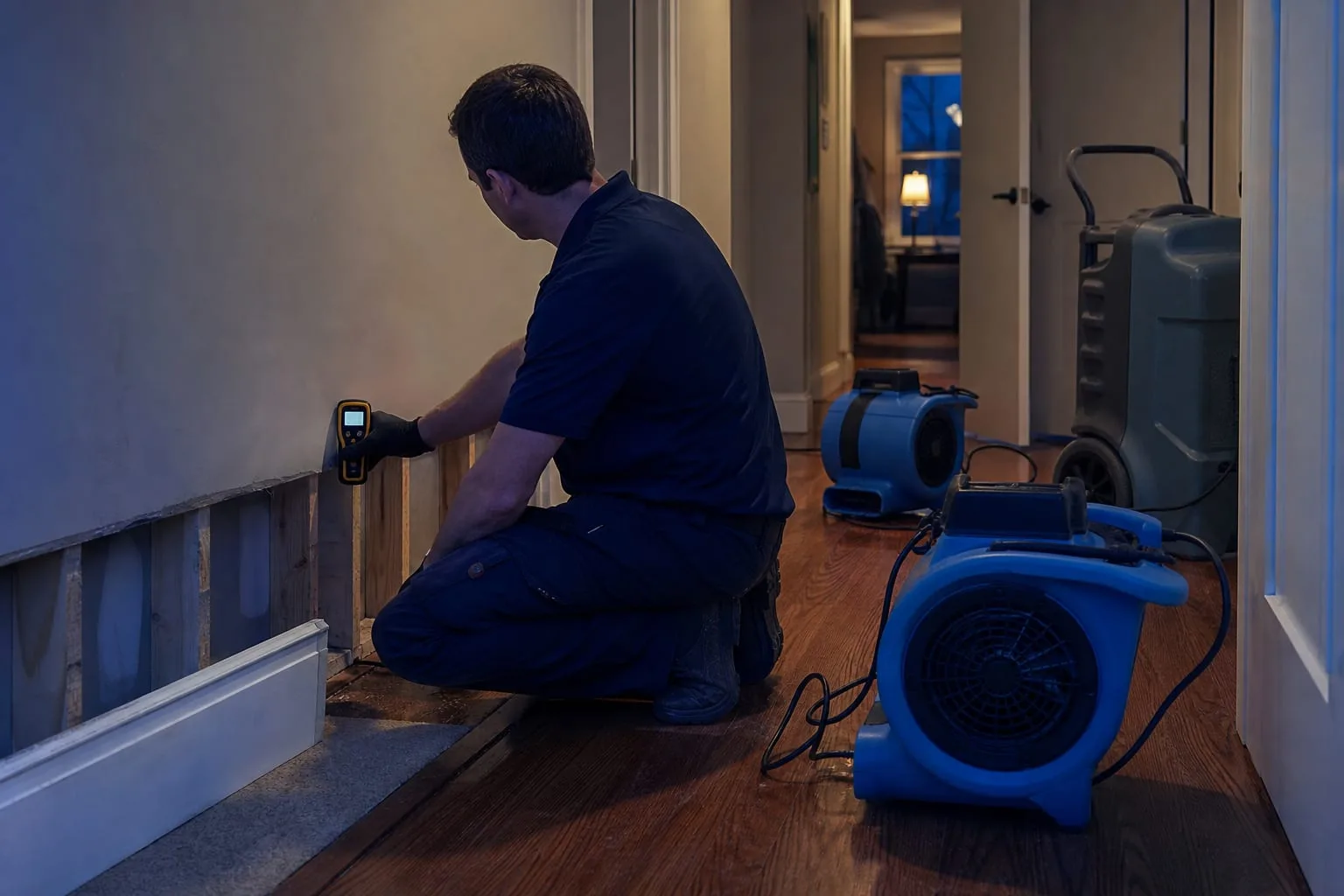
Three days is the number most homeowners hear, and it did not come from nowhere. It comes from the way the water restoration trade organized itself, first through the certifying bodies that appeared in the early 1970s, then through the written standard for water damage work that arrived in the mid-1990s and gave adjusters something to point at. That standard describes a drying goal, not a calendar. The three days is an average, drawn from thousands of jobs on gypsum board and framing lumber in ordinary conditions. Your house is not an average, and the crew standing in your hallway knows that better than anyone.
The equipment got faster before the buildings did
Until refrigerant dehumidifiers designed for low grain depression became common on job sites in the 1990s, drying a wet structure largely meant air movement, open windows and patience, which is why the older repair habit was to cut out and replace anything soaked. The newer machines changed the economics: with enough air movement and enough moisture removal, much of the assembly could be dried in place. What did not change is the physics of a material releasing bound water from its interior, and that is where the split between drying properly and drying quickly actually lives. A surface can read dry within a day. The core behind it may be weeks from equilibrium.
Someone who has run hundreds of these jobs will tell you the same thing in slightly different words: the dryers are fast, the framing is not, and the only honest way through is measurement. A technician who has been doing this for fifteen years does not argue about the drying schedule. He argues about where the probes went.
Four people who are quietly judging the same wall
Your decision sits next to at least four other people's work, and they each define a dry house differently. The restoration technician wants readings that track downward day over day toward a dry standard taken from unaffected material in the same building. The adjuster wants the daily logs, because equipment on the floor for nine days without documentation is the sort of line item that gets trimmed later. The flooring installer wants a subfloor within the moisture range that his adhesive manufacturer will warrant, which is often tighter than the restoration standard. The painter and the drywall crew want a cavity that will not push moisture back through a fresh coat in August.
Those four thresholds rarely land on the same day. The one that governs your repair is whichever comes last, and the expensive mistake is letting the earliest one end the job. A floor installed over a subfloor that met the restoration standard but not the adhesive spec will cup, and the argument about who owns that failure is one nobody wins cleanly. The Environmental Protection Agency is the federal body responsible for guidance on indoor mold and moisture in buildings, and the practical thrust of that guidance has always been the same: dry it, verify it, then close it.
What to ask before the machines come out
Ask what the dry standard is for this job and where it was taken from. A good answer names a material, a location and a number, something like the interior wall in the far bedroom that never got wet. A poor answer is a generic percentage with no reference point, or the phrase that it feels dry. Ask which readings are surface and which are penetrating, and how the cavity behind the baseboard is being measured rather than inferred. Ask whether the daily log will be shared with you as it is taken, not assembled at the end. Ask what the plan is if a reading stalls for two consecutive days, because stalling is common and the response to it is the real test of a crew.
Then ask the two questions that decide the repair. Which materials are being dried in place and which are being removed, and what specifically drove each call. And what number does your flooring or drywall contractor need before he will start, since that number, not the drying certificate, is the finish line. A technician who has done this many times answers both without hesitation, because he has been on the phone with the installer before.
Where speed is genuinely worth paying for
Extraction speed matters enormously, and this is where a fast crew earns its money. Water pulled out mechanically in the first hours is water nobody has to evaporate later, and the difference between an eight-hour response and a two-day response shows up in the drying schedule, the demolition scope and the claim. Removing baseboard, drilling the bottom plate and getting airflow into the cavity early can turn a tear-out into a dry-in-place. Speed at the front end shortens the back end. Speed at the back end, meaning equipment pulled before the numbers say so, just moves the cost into your flooring invoice.
The distinction worth carrying into the conversation is between urgency and haste. Urgency is a crew on site the same evening with extraction gear. Haste is a sign-off sheet on day three with one reading on it. Ask for the readings, keep the log, and hold the close-out until the installer who has to warrant his own work says the number is where he needs it.