Deciding What to Hire Out? One Household Sorted Four Upkeep Jobs by What Drives the Price
A household priced out four recurring upkeep jobs and found the estimates disagreed about scope, not about labor. Here is what each term on the page commits you to.
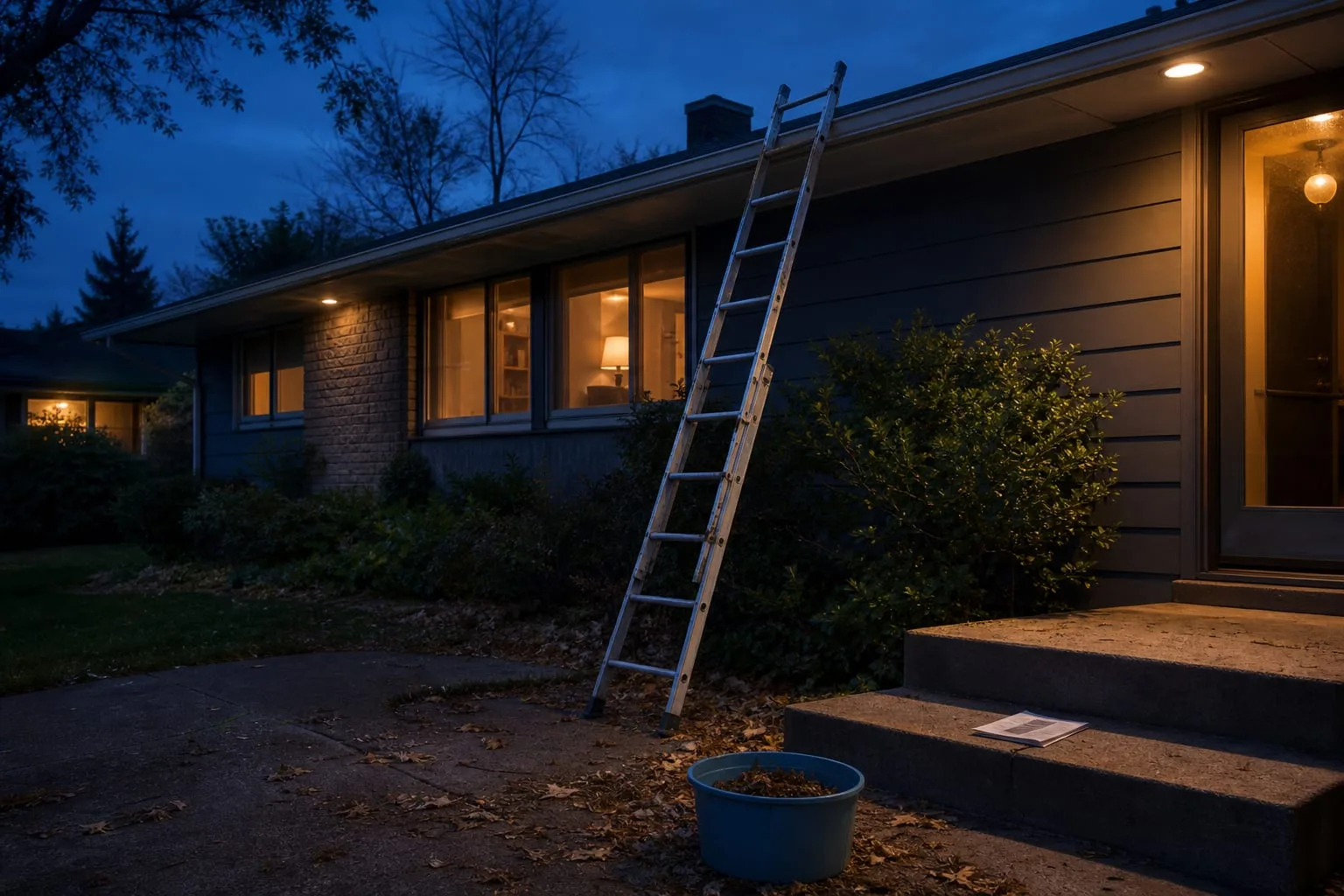
A household in a 1,900-square-foot house built in the early 1960s spent one fall collecting estimates for four jobs it had always done itself: routine interior cleaning, gutter clearing, exterior window washing, and the twice-yearly work on the dryer duct and range hood. The estimates came back so far apart that the first assumption was price gouging. It was not. Three of the four quotes described different work using the same nouns, and the household had no vocabulary for the difference. Sorting that out took longer than any of the jobs.
Why the interior quotes could not be compared
Two cleaning companies quoted the same house, and the numbers were roughly double each other. The cheaper one had priced a recurring maintenance clean: surfaces at standing height, floors, fixtures, and nothing that required moving furniture or a step stool. The other had priced an initial deep clean, which in the trade means baseboards, door casings, window sills, the tops of cabinets, appliance exteriors and interiors, and the grout. Deep clean is not an adjective. It is a scope, usually billed once, after which the recurring rate applies to holding that condition rather than reaching it.
That two-tier structure is older than the franchise cleaning industry that popularized it in the 1980s, and it exists because the first visit is unpredictable and the ones after it are not. A crew can estimate a maintained house within a narrow band. It cannot estimate a house it has never entered. The initial charge absorbs that risk. If you decline it and start on the recurring rate, most companies will either add hours as they find them or simply leave the backlog in place, which is the version that generates the complaint about work not being done.
What actually moves the number
Square footage is what homeowners quote and it is close to the least useful figure on the page. What drives labor is the count of surfaces and edges: bathrooms, sinks, interior doors, stair treads, blinds, and the amount of loose material sitting on horizontal surfaces when the crew walks in. Two houses of identical footprint can differ by half again in hours because one has three bathrooms and open counters and the other has one bathroom and a full mantel. Frequency matters in the same direction. Weekly visits cost less per visit than monthly ones, because the work compounds between them.
Access is the other lever, and it is the one that separated the exterior jobs from the interior ones. A single-story gutter run reachable from a stepladder is priced as an hour of labor. The same linear footage two stories up, over a deck, is priced as a different category of work entirely, because the crew arrives with different equipment and carries different insurance to be up there. The Occupational Safety and Health Administration is responsible for fall protection standards on that kind of work, and the cost of complying with them appears in the estimate whether or not the line item names it.
The two jobs that were worth hiring out
The household kept routine interior cleaning in-house and paid for the initial deep clean once, which is a defensible split: the expensive part was the backlog, not the upkeep. Gutters and second-story windows went to a contractor permanently, and the reasoning was not time. It was that a fall from a ladder is the single most expensive outcome available in residential upkeep, and that a homeowner on a ladder is uninsured labor. The dryer duct and range hood went out too, because the tools that clean a duct properly cost more than several years of service calls.
Before either exterior job was booked, the household asked for a certificate of insurance naming general liability and workers' compensation, sent directly from the insurer rather than forwarded by the contractor. That is a routine request and a competent outfit produces it in a day. Without workers' compensation coverage, an injury to a crew member on your roof can arrive at your homeowners policy, which is a far larger exposure than the price of the job. The certificate is the cheapest document in the transaction and the one most often skipped.
The terms to settle before the first visit
Ask whether the rate is per visit, per hour, or per crew hour, because three people billed at a crew-hour rate is a different invoice than three people for one hour. Ask what a trip charge or service minimum applies to, since short jobs often price at the minimum regardless of duration. Ask which items are add-ons: interior refrigerator, oven, interior windows, blinds, and finished basements are the usual four. Ask whether supplies and equipment are included. Then get the scope in writing, item by item, so the next invoice is a comparison rather than a surprise.
The household's final arrangement cost more per year than the do-it-yourself version and less than the first round of quotes suggested, because it had stopped buying work it did not need and started buying the two jobs where hiring out bought something it could not supply itself.