Buying an Estate Diamond Privately? Five Questions to Ask Before the Money Moves
A 1.2 carat solitaire in an old setting, sold for cash by a stranger: the five checks that separate a good buy from an expensive one, and what a weak answer sounds like.
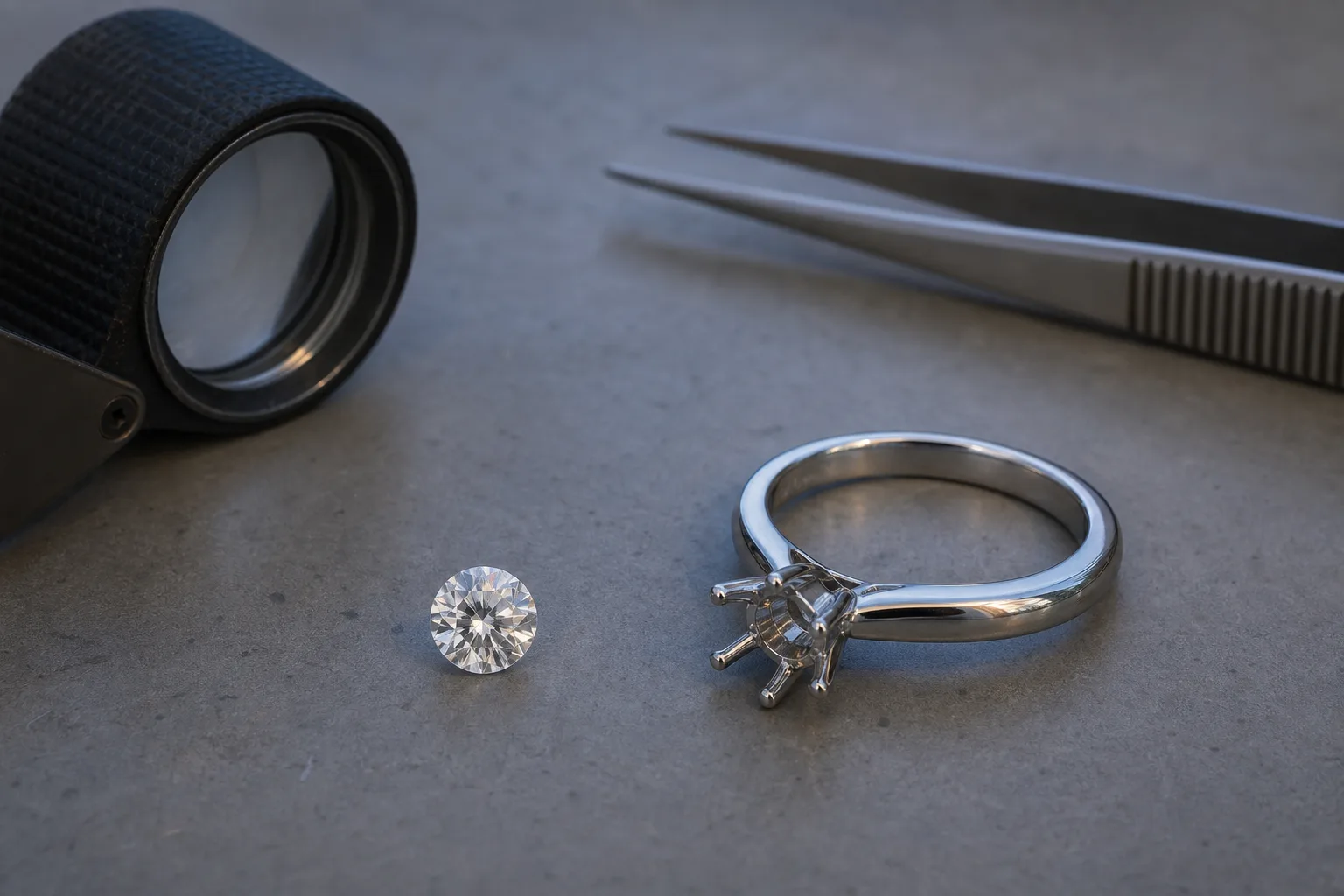
Consider a narrow case, because the general advice on buying jewelry is nearly useless at the moment money changes hands. A stranger is selling a 1.2 carat round solitaire in a white gold six-prong setting, inherited from an aunt, listed on a marketplace app at a price that is roughly half of what the mall jeweler wants for something similar. You have agreed to meet. The ring looks right, the seller seems honest, and neither of those observations is evidence. What follows are the five things worth checking in that half hour, and the answers that should slow you down.
One. Who issued the report, and can you look up the number yourself?
Ten years ago a grading report was a piece of paper, and verifying it meant trusting that the paper matched the stone in front of you. That gap has largely closed. The major laboratories now maintain online report lookups, and stones graded in the past decade usually carry a laser inscription on the girdle, a report number readable with a loupe at around ten power. The check takes two minutes on a phone. You pull up the lab's verification page, type the number, and compare the carat weight, measurements, cut grade and fluorescence against the stone.
A good answer sounds like a seller who already knows the number and offers to let you read the girdle. A weak answer is an appraisal, not a report. Appraisals are written by the selling jeweler or an independent appraiser for insurance purposes, and they state a replacement value rather than a grade. If the only document is a valuation on store letterhead with a dollar figure at the bottom, treat the stone as ungraded and price it that way. Ask directly whether a laboratory ever examined it, and who.
Two. Natural or lab-grown, and how does the seller know?
This is the question that did not exist in its present form a decade ago. Around 2015, laboratory-grown diamonds moved from a curiosity into ordinary retail, and by the early 2020s they were common enough that testing became routine rather than exotic. A lab-grown stone is a real diamond, chemically and optically, and no amount of squinting through a loupe will settle the question. Older thermal testers cannot distinguish them either. The wholesale price gap between the two is large and has widened, which makes the distinction the single biggest variable in what you should pay.
So ask how the seller knows. The honest inherited-ring answer is usually that they do not, which is fine, and the price should reflect it. Reputable lab-grown stones carry their own inscriptions and reports, and a stone graded since roughly 2019 will say plainly which it is. The Federal Trade Commission is responsible for how jewelry is described and advertised to consumers, and the vocabulary sellers use has tightened accordingly. If someone insists a stone is natural with no report and no testing, ask them to put it in writing on the receipt.
Three. Is the metal what it is stamped, and is the head original?
Turn the ring over and look inside the shank for a karat stamp, 14K or 585, 18K or 750, and for a maker's mark. Then look at the head, the small basket that holds the stone. Prongs wear out, and a replacement head is normal maintenance rather than a defect, but a head that looks newer and brighter than the shank tells you the ring has been apart at least once. That matters because it means the stone in the setting is not necessarily the stone the setting was built for, which undercuts any story about the ring having been bought as a unit in 1974.
The check you cannot do across a table is metal purity, so build it into the deal instead. Ask whether the seller will accept payment contingent on a bench jeweler's inspection within a day or two, an appointment you make and pay for. Plated silver and low-karat alloys sold as gold are an old problem with old solutions, and any local jeweler can test the metal, check the prongs, weigh the stone and measure the table in about twenty minutes. A seller who agrees without hesitation has just told you a great deal.
Four. Where did it come from, and can they prove the right to sell it?
Estate jewelry travels through divorces, probate, pawn shops and, occasionally, burglaries. Buying stolen goods in good faith does not make them yours, and the recovery process runs through a police property room rather than a refund. Ten years ago there was little a private buyer could do beyond forming an impression of the seller. Now there are searchable databases for serial-numbered items, which matters most for watches, and pawn transaction records that law enforcement queries in many jurisdictions. For an unnumbered ring the paper trail is what you have.
Ask what the seller has: an original sales receipt, a probate inventory, an insurance schedule listing the piece, a pawn ticket showing redemption. Any one of those is a reasonable chain. Then ask for a written bill of sale with the seller's legal name, address, a description of the ring, the price, the date, and a line stating that the seller owns the item free of any claim. Photograph their identification with permission. A private seller with nothing to hide finds this tedious, not offensive, and will sign.
Five. Which number is the asking price built on?
Every piece of jewelry has at least three numbers attached to it, and sellers reach for whichever one flatters them. There is the retail replacement figure on an insurance appraisal, which is deliberately high because it funds buying a comparable piece new. There is the auction or resale figure, which is what the market actually pays a private party. And there is the trade figure, which is what a dealer would hand over in cash today. The spread between the first and the third is wide enough that two people can argue about a fair price for an hour while both citing real documents.
The useful question is blunt: what would a dealer pay you for this tomorrow, and have you asked one? A decade ago that question was nearly unanswerable outside the trade. Now the comparables are public. Auction house results archives, the completed-listing histories on resale platforms, and dealer buy prices for graded stones of similar weight and color are all searchable before you leave the house. Arrive with three comparables printed or screenshotted, matched on carat weight, color, clarity and cut grade, and the conversation stops being about who feels the price is fair.
Run in that order, the five checks take perhaps forty minutes plus a bench jeweler's appointment, and they cost less than one percent of what you are about to spend. The version of this transaction that existed in 2015 relied heavily on the buyer's read of the seller's character. The version available now relies on a report lookup, a database search, a set of comparables and a signed bill of sale, which is a considerably better foundation for handing a stranger several thousand dollars in a coffee shop.